Showing posts with label Finance. Show all posts

Tuesday, 15 January 2013

Give us our Daily Tickers

Have you heard of RELIANCE? Yes, that Ambani company. The fellows that keep arguing about how much gas they're producing. But it's also called RIL. And RELIND. Or RELI.
Whoa, you think. These are the same company? Why so many names? Or, in twitter parlance, "Why U No Call It Reliance?"
Because we don't have a common ticker system for stocks. The NSE has its own set of stock codes. The BSE gives stocks both a code and a 6 digit number, which old-timers are proud to know by heart. Because the exchanges wouldn't settle on a common naming convention, brokerages that needed to sell stocks decided that they will have their own names; ICICI Direct calls it RELIND, while NSE calls the company RELIANCE and BSE uses RIL.
Given that there are at least 10 large brokerage outfits, with each one using the symbols they want, the "ticker" confusion remains. Does RELINFRA mean Reliance Infrastructure? Or Reliance Industrial Infrastructure? Both are run by an Ambani, but a different one. My broker had  the RELINFRA for the latter company, and I tried to buy shares online thinking it was the former - I was lucky that their prices were so different (the first one was in three digits, the second in two) that the order was rejected for being way out of range. The brokerage in question has since shifted to the NSE symbols (which use RELINFRA and RIIL respectively) possibly to avoid frantic support calls from people less fortunate than me.
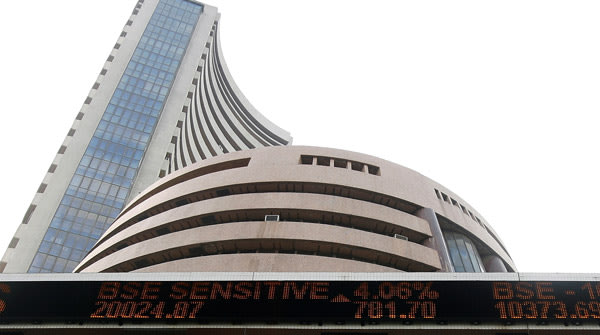
Ticker symbols on TV and web sites take their own hues; if you watch the price disappear across the screen by the time your mind has decoded the symbol, you are not alone.
bse-sensex-201011-600
And then, you get the symbol changes. Companies change names often, and then their ticker symbols change. HEROHONDA dropped the Honda name after the Japanese giant dropped out of the partnership - the company is now HEROMOTOCO. The famous Infosys was "INFOSYSTCH", and we had a "TCSCONS" - they were recently changed to "INFY" and "TCS" respectively. Demergers and mergers impact name changes - Larsen and Toubro (L&T) was demerged into, well, Larsen and Toubro (Now LT) and Ultratech Cement (ULTRACEM).
While one can't really ban name changes, a standardized ticker will make a change undesirable, since the ticker adds to the brand value. We can't underestimate the power of a ticker symbol - even when Bombay was rechristened Mumbai, they didn't want to change the "BEST" name for the electricity and transportation provider, so it became "Brihanmumbai Electric Supply and Transport" - still "BEST" in short.
In the US, each stock has a ticker symbol that remains the same everywhere. I look for a symbol - say GE - and it is GE no matter where you look: on TV, on a web site, on the SEC site or in a newspaper. The ticker symbol also has few characters - AMZN (Amazon) and YHOO (Yahoo) have four but you'll even find single letters (G for Genpact).
In India, SEBI has standardized a number of things across exchanges. For instance, the reporting standard for financial results has been made standard - the exact headings have been determined and each company has to produce the same information - Revenue, Total Expenditure, Net Profit, and Diluted Earnings per Share and so on. (Note: the actual headings are longer and unintuitive but at least we have a standard) Before these rules each company would have a different format - some called it Revenue, others called it Income, yet others called it Sales. The standardization process helps in keeping companies comparable.
Secondly, they have standardized, to an extent, the filing of certain types of transactions. Insider trading information - where company management or promoters buy or sell stock - were reported by different companies in different ways, which made it difficult for anyone to know what really was going on. The standard now ensures that companies file such information in a standard format - telling us when they bought or sold, how many shares were involved and what was their holding after the transaction.
Similar standardization has occurred in reporting of promoter share pledges, shareholder details (released every quarter), substantial acquisitions (above 5% of holding) and so on.
Soon, with a shift to XBRL (an XML based report that has a predefined structure) this will go a step further in terms of standardization across exchanges - and indeed, with SEBI, The Ministry of Corporate Affairs and the Reserve Bank of India adopting XBRL together, a single unified standard of reporting across different regulators.
With that level of standardization, it is indeed a shame that we can't have a common "ticker symbol" for each company. Sure, they have a long name which is unique, but who uses that? It would be terribly difficult to have a conversation about Carborundum Universal Limited if you weren't allowed to use some sort of abbreviation; and its best that we have a unique abbreviation as well.
Note that I don't call for SEBI to choose a symbol - the companies must have that choice. But certain ground rules must apply - a maximum number of characters, for instance, so an abbreviation doesn't become alphabet soup, and an element of relevance - so an ABC Toilet Seat Paint Manufacturers Limited doesn't take the symbol "WIPRO".
The change is simple, but never really thought of as important. Only brokers needed to care about symbols earlier, since you'd call and mumble the name of the company you wanted to buy. But now, you get a terminal to make your own trades, websites to research and TV channels and running tickers on your mobile phones; a common "short name" would be quite useful.
A rose by any name will smell as sweet, but even if you're a card carrying BJP member you're going to find it difficult to deeply connect with a Nelumbo nucifera.

The Derivative Alternative

While derivatives have been called weapons of mass destruction and worse, they can provide alternative methods to participate in the markets. To a bystander, these instruments seem complex — and some indeed are so, with SEBI now requiring brokers to ensure that investors are financially capable of handling themselves before they can trade derivatives.
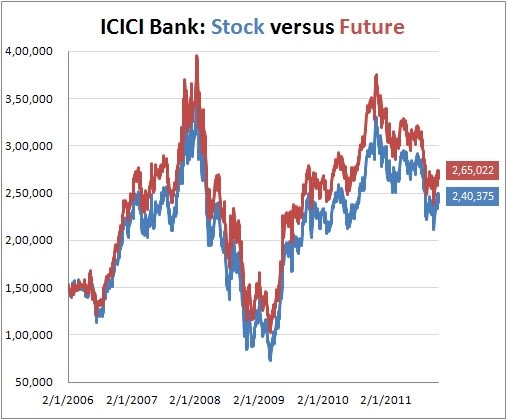
An alternative way to buying stock is to use a "future". Instead of having to buy equity into a company and paying up the full amount of money, we use a derivative and buy the future instead, paying only a margin amount upfront, and putting the rest of the money as cash, which can earn interest in a liquid mutual fund. I tracked the stock of ICICI Bank, bought directly versus buying with a future, since 2006:
ICICI
I've assumed a single lot of 250 shares, bought for about Rs. 150,000 in 2006, that returns, with dividends. (further assumptions — 30% margins, and the return on cash is 5%)
The futures approach is 10% higher in terms of total return over 5 years! But is it really better?
The correct answer: it depends on who you are. The disadvantages of this system are mainly in the taxes.
a) You get no dividends with futures. While the gains might be baked in somehow, dividends aren't taxed in your hands, so a certain percentage of the dividend gain is lost.
b) You get taxed as business income: Futures trading is considered business income, which is taxable. If you were to lose 30% of your gains to taxes, that negates the entire difference with buying stock. In the example above, the stock gained a total of Rs. 90,000 for which, because of tax rules in India, you pay no tax. (Long Term Capital Gains is nil) But the gain through futures is Rs. 115,000, and a 20% tax will bring it down back to the levels of the stock gain itself.
c) You get no voting rights. Derivatives provide no ownership rights. But hardly any investor votes nowadays, so this is not so much a disadvantage.
d) The process has pain. With a rollover every month, and mark-to-market gains or losses that need a transaction every day, it's a lot more effort for the lay investor.
The "who you are" helps: for many foreign institutional investors, gains or losses may not be subject to Indian tax laws, in which case the above disadvantages are many. It would help many Indian institutions as well (such as mutual funds or insurance companies, which aren't taxed on gains) but they have strict regulations about how much exposure they can have in derivatives.
Lastly, a trader or a proprietary trading house might benefit from using futures; the taxation disadvantage might be offset by business losses or valid expenses, and will justify the returns.
And there are advantages. For one, you can participate in the downside. Sometimes stocks get overvalued, and it is considered proper trading to short-sell a stock, expecting to profit from a price decline. But in India, you can't short-sell stocks, because there is no liquidity in the "borrow and lend" market.  Futures give you an easier way.
Creeping acquisition rules do not allow individuals to hold stocks without notifying the exchanges and thus, the public — so a large chunk of shares acquired will trigger interest and could take the price high before an organization can finish its buying. Futures, on the other hand, have no disclosure requirements so a buyer could participate in the growth of a stock with no one else ever getting to know.
This lack of disclosure creates many problems as well. In 2008, shares of Volkswagen went up more than three times as Porsche, its owner, declared that it now owned 75% of VW through some derivative instruments. Short sellers — who had a negative view of the stock — had to scramble to buy back shares which were not available (as Porsche had effectively cornered most of the free float), and for a while Volkswagen became the world's most valuable company. The main issue was that Porsche never disclosed the stake, since it wasn't required to report derivative positions. Regulators have realized that derivatives need to be brought into similar disclosure norms that equity shares require.
In India as well, Reliance Industries got into trouble — and still is — for having profited through derivatives in the shares of a subsidiary (RPL) before it sold shares on the market. While creating a hedge, Reliance had used futures to short-sell RPL shares that it eventually sold; but it seems that in the process, it took on greater positions than would be considered a hedge, and therefore is being investigated for insider trading.
It is also quite likely that much of the insider trading market has moved to single-stock futures. Promoters must reveal every single share they buy or sell, but not their futures and options trades. On a piece of news that is known only to a board member, a quick profit can be made through a futures transaction with very little chance of being caught. I would be surprised — given the low level of enforcement or investigation in futures trades — if this is not rampant.
Finally the derivatives bazaar gives you the ability to take more than a "Stock Will Go Up" or "Stock Will Go Down" approach. You might believe that a stock will stay in a range. Or, that the stock will go down, but not too far down. Or that it will go wildly in either direction.  With the use of options, along with a stock, you can create synthetic positions that let you profit from even such imprecise notions. Traders have named them exotically, so you will hear of Strangles, bearish put spreads or straddles — the respective positions you will use to trade the aforementioned beliefs.
It is such synthetic positions that have been used to create "structured products" — where, with options, futures and cash management, a financial product can offer you "complete downside protection with 100% upside" — meaning, you lose no money if the market falls, but you make just as much if it goes up. These products are very useful for a risk averse audience, who might otherwise never even participate in the markets.
Given that we just saw a global crisis because of abuse of derivatives, it is only logical to be afraid of them. But if real estate stocks have fallen 90%, stocks aren't necessarily risk free either. If you consider that we sit in November 2011 at an Index level that is about the same as January 2010, that the US markets are about at the same place they were 11 years ago, or that Japan has fallen 75% from its highs 30 years back, it will seem useful to explore alternative investment strategies that don't require the market to go straight up.

Buying Back Our Deficit


The government has not been able to divest public sector company shares in the market, due to depressed investor sentiment as markets have fallen over 20% in the year. The lack of this "extra" revenue means that total government receipts — or "income" — have fallen 18% compared to last year (as of October 2011). With expenditure growing at 10%, the fiscal deficit is at Rs. 3  lakh crore, which is already about 4% of GDP. It is only expected to grow.
Last year, a significant amount of revenue came from non-tax income. A Rs 100,000 cr windfall was made from the spectrum auctions to telecom companies, and another Rs 22,000 cr came from divestments in government owned enterprises like Coal India, SAIL, and MOIL. The divestment target for FY 2011-12 was Rs 40,000 cr, of which the government has only managed a little more than Rs 1,100 cr through a follow on offer of PFC.
Recently the government has been asking public sector companies to buy back their shares to help plug the fiscal deficit. This is an interesting move — it wants government-owned companies which have surplus cash reserves, to use that money to buy back their shares. In India, buyback procedures have strict rules, to prevent rogue promoters from siphoning cash into their own pockets.
Companies can buy back shares in two ways.
Market buybacks are where the company decides to buy its own shares back from the market. They first take shareholder approval for how many shares they intend to buy, at what maximum price, and for how long they will do it. A merchant banker is then appointed, and the company reveals to the exchanges how many shares it bought back every day, until the goal is met or time runs out.
While many companies have taken this route, it is largely a method used to pull wool over investors' eyes. The announcement of a market buyback is largely intended to keep the share price high in anticipation; the reality is that it does nothing because companies, for the most part, don't really intend to buy a lot of shares back. What they do is try to rig the share price upwards, going by the public disclosure of shares bought or sold each day; if the share price goes up, the buyback on that day is furious, but if the share price falls, the purchases go down to a trickle. Having learnt this over the years, investors do not pay much heed to market buyback announcements.
The government can't use a market buyback approach —it's not actively trying to sell shares in the market, for one. For another, the anonymous trading exchanges don't allow you to selectively buy from one participant — the best price will always win. That means the government can't ask a merchant banker to buy government owned shares first; the shares purchased will be those with the lowest "offer" prices in the market.
The other form is the "tender offer" buyback. Companies can use spare cash to buy shares back from all investors who tender their shares, in a proportionate manner. Piramal Healthcare did this recently, when it sold part of itself to Abbott for over Rs 16,000 cr. The buyback at Rs. 600 was way more generous than the existing stock price (Rs. 460). Since only 20% of the company would be bought back, if all shareholders tendered their shares, only 1/5th of any investor's shares would be bought back (the rest returned). Piramal Healthcare ensured a "proportionate" buyback — that is, where a portion of every investor's tendered shares would be bought back, not favouring anyone in particular.
Proportionate buybacks mean that the buyback must be offered equally to all investors, and where the government owns only 50% of shares, it cannot hope to get more than 50% of the money used in such a buy back. The government will have to use this route, and it holds around 90% in many profitable PSUs. Yet, they can't be asked to pay their entire cash hoards to buy back shares (they will need capital to survive or grow, and they are likely to have debt on which interest must be paid).
The subject of buybacks is also important for unlisted companies or startups. In some cases, a co-founder or an early investor intends to leave, and the company has the money to buy his shares back. But the buyback rules stipulate that all investors must get to participate; so to get one investor out, startups will need to convince all other investors to stay in (and thus, not tender their shares). Subsequently, for six months, the company can no longer issue new shares, which means the exit of one investor will delay any fund raising rounds.
Using buybacks to fund the deficit might solve the immediate problem for the government but it really should consider divesting stake even at depressed prices. There is no reason for keeping 90% of a Coal India or 84% of an NTPC. There is demand at low prices; prices that are still high enough for the government to cover a deficit. But it seems that the government has gotten enormously greedy when it comes to IPOs, as nearly every of their recent IPOs is off substantially. An example: NHPC — a nice hydro power utility company — was priced at a ridiculously high price of Rs 36. More than a year of disappointment followed, and even with much improved performance, the share languishes at Rs 23, and IPO investors have lost a third of their money. The MOIL share is also down 30%, in what seems like another overpriced IPO. To regain investor interest, IPOs must be priced much lower.
If the cash is available in their companies as a real surplus, then the government could use dividends as a better way to pay themselves; at one level the government will get a dividend, and at another, the dividend tax of 15% comes straight to them as revenue. It also avoids the associated costs of a tender-offer in the form of SEBI approval and banker fees.
Yet, the amount of money the government gains from the exercise will take money out of the corporate and into the hands of an entity that is likely to fritter it away in useless bailouts such as Air India, which has requested Rs 43,000 cr till 2021.  The idea of taking from performing enterprises and putting it into non-productive areas has only political benefits, not economic ones. Tomorrow, don't be surprised when conservative taxpayers will be asked, through higher taxes, to pay for an increasingly profligate public sector. I wonder what it will take for us to buyback governance.

What To Make Of The Great EU Announcement

Twenty six of the 27 European nations decided to move forward with "tighter integration" and a closer "fiscal union" which seems to have cheered markets tremendously. (The lone dissenter was the UK.) These grandiose statements provide way too little detail in exactly how such a pact would work, and be palatable to the vast electorate at the same time.
The idea is that a tighter control of both spending and taxes by a central body will ensure that no country will go overboard and thus harm the Euro. The central body would almost surely be loaded towards Germany and France, and why would a Greece, a Holland or a Portugal allow such a body to not just determine how much tax they would pay, but also how much they can spend and on what? It is highly unlikely that just because German and French banks own the debt of certain countries, that Germany and France will be allowed to violate their sovereignty; although it is a big statement, I doubt everyone will see eye-to-eye when Germany decides that Italian pensioners need to take a 10% pay cut.
The decision making process — which currently requires an okay by all Euro countries —  could be changed to introduce an "85 per cent supermajority", which means a small country can't hijack an issue by voting against it. France and Germany want this — they are part of the 85% - and opponents are smaller nations like Finland and Slovakia.
Also, the leaders mention that there will be "penalties" for any nation violating spending or collection rules. But even Euro membership came with rules, like a 3% fiscal deficit and a 60% debt-to-GDP limit, both of which have been violated continuously, even by Germany (debt: 83% of GDP). It's not entirely clear how a penalty can be a deterrent if it hasn't been enforced earlier. ("If you don't stop, I'll say stop again, and louder!")
Finally, think about how it will work: An euro country, like Portugal, decides to spend too much on, say, schools. The European Court of Justice decides this is unacceptable by deficit considerations and refuses to allow it. The Portuguese people protest; like the Greeks are protesting now against externally enforced austerity. This sort of thing simply won't work unless they're all willing to be one country, and one region is willing to sacrifice for the sake of another.
The plan needs to be cobbled together into an agreement and then passed by voting in all EU countries, which they say will take three months. This sounds implausible; getting the Euro on the road took over 9 years after the first agreement. The democratic nature of the EU requires citizens to be with the program, and it's quite unlikely the voter in Germany sees things on the same level as the one in Greece. And within three months? Don't hold your breath.
This is only important because Europe needs a solution fast. Bloomberg says more than 1.1 trillion Euros of long and short-term debt will come due in 2012, much of it in the first half alone. Recently, Italian bonds crossed yields of 7%, only coming down as the ECB stepped in to buy bonds. But bond buys by the ECB, reek of moral hazard — the banks that bought this debt originally made a bad investment; they are getting bailed out by the ECB, which in turn is backed by every taxpayer in the Euro region. The idea that the privately taken risk — by a bank — is being transferred to the taxpayer was frowned upon by Germany, which insisted that private lenders be forced to take a part of the hit. On Thursday, though, they climbed down from that position, because of fears that if private lenders take a hit, they will contract future lending and hurt everyone in the short term.
This is a justification used often — that we need a "lender of last resort" and that the US Fed has paved the way by intervening in 1987, 2000 and 2008. Recently, it has lent $29.6 trillion in total — the maximum outstanding on any day was $1.2 trillion, which is about 12% of the total US money supply (M2). In comparison, Indian money supply is Rs 50,00,000 crore, and even in the crisis less than Rs 150,000 crore was borrowed overnight by the banks.
On Thursday, the ECB committed "unlimited" funds to banks for three years, and lowered interest rates to 1% from 1.25%. Additionally, it made collateral requirements looser — banks are supposed to pledge something in order to borrow from the ECB, but it seems that now the ECB will accept just about anything printed on a piece of paper. This, they hope, will encourage banks to buy government bonds — after all, they can pledge those bonds to the ECB for the money. This is the way the ECB intends to get away from the German opposition to actually printing money and buying those bonds themselves. (The Germans are scared of printing induced hyperinflation — they faced the specter of it in the 1920s when they printed up to 60% of the country's money supply every day)
Additionally, the 17 Euro countries and the 10 others in the EU will provide 200 billion Euros to the IMF, in what is another circular way to invest in troubled country debt, since that is what the IMF will buy. A "European Stability Mechanism" (ESM) will be created with a capacity of 500 billion Euros to further help. There are, again, no relevant details.
But is it enough? Just Italian debt totals over 2 trillion Euros. The EFSF, with 440 billion Euros, is now considered adequate for just Greece. The magnitude of the problem is far greater than the money being readied to attack it, and taxpayers in the region are already balking at the size of the current war chest. With every increase requiring negotiation between more than 20 entities, and Germany firmly opposed to printing money, there will be consternation at every mini-crisis that happens.
One alternative is for countries to break away from the monetary union and issue their own currencies. While this seems unlikely, it will be a real decision if talks reach a deadlock — and a Euro exit may cascade into a point where the Euro ceases to exist. The uncertainty caused by such a decision will surely put much of the world into recession, but it may be a better idea than having multiple nations with vastly different economic situations attempting to have central governance.
For troubled countries, issuing their own currency and devaluing it will increase their competitiveness; who it will hurt is Germany, which hugely dependent on exports, and which will see its own currency rise in comparison and thus, hurt its exports.  But it will undoubtedly destroy the banking system as we know it today, though some would say they will only be replaced by different, stronger banks in the future.
A Euro breakup will impact the entire world, but it seems like it might be better than keeping us in limbo forever. Will the agreement, if it happens, change everything? The next three months will tell.

Protecting the rupee by freeing it

The Rupee has breached new lows while the dollar continues to strengthen to Rs 54 and more. Indeed, the December quarter has already seen a drop of more than 10%, after another 10% fall in the previous quarter. But what has caused the rupee to fall?

The "Current Account" deficit
That's what you hear about. We import things. We export other things. Our beloved NRIs send money home ("remittances"). We pay interest on borrowings from abroad. If you sum these up, you get a "current account" balance which is, for India, usually negative.
From April to November 2011, India exported $192.7 billion worth of goods, while imports were $309 billion. The trade deficit is thus more than $116 billion. Adding transfer payments and software services, the "current account deficit" is about $70 billion for the first seven months of the year.
Much of the deficit is fuel — we have already imported $70 billion worth of oil this year (we import 2/3rd of what we use).
The fact that we run a current account deficit is not new — we have done it for ages now. How then did the dollar stay low? Answer: People wanted to invest in India, so they sent money through the "capital account" — FIIs (Foreign Institutional Investors) brought in money to buy stocks and FDI (Foreign Direct Investment) into the private sector helped bring in the dollars.
Those flows have now dried up. By definition, a current account deficit is ALWAYS financed; so where you can't offset it with capital account inflows, you will find that a deficit will involve the depreciation of the currency. Essentially, since we run a deficit, we need more dollars than we get. The excess demand for dollars depresses our currency.
But the problem isn't just that we run a current account deficit. It is also that we managed to somehow get hugely dependant on capital inflows, which fuelled our economic growth without letting the rupee depreciate too much. In fact the rupee wasn't allowed to strengthen, with the RBI intervening at every moment possible and printing rupees to buy dollars, just so we could retain the rupee above 40. The RBI now owns more than $300 billion of dollars.
Why not have the RBI just sell the dollars they have?
The RBI doesn't want to intervene, and a falling rupee makes our exports really competitive. But the RBI has intervened in the past, mostly to buy the dollar and thus stop the rupee from rising. Doing that creates inflation, as the RBI prints rupees to pay for the dollars it buys. In the other direction, selling dollars requires that the RBI takes the resulting rupees out of circulation.
But the RBI doesn't want to do that, because there is already a shortage of rupees in the system. With rising interest rates, money is scarce and there is so much demand that banks are borrowing in excess of Rs 100,000 crore per day from the RBI (overnight).
Exits: Europe, Policy Paralysis, Overspending and Debt repayments
The problem in Europe has spooked investors, who will not return until the uncertainty around the area comes down. The European problem is so large that it overshadows our economy by a factor of 10 or more, so we shouldn't expect small mercies from those in the line of fire.
The Indian government has itself in knots. The great corruption scandals of 2010 hurt its credibility, and the resulting outrage has stopped all policy action — including having an entire session of parliament voided after protests. Most reforms have been placed on the backburner, avoiding confrontation with a belligerent opposition. A recent proposal to increase FDI in multi-brand retail — an idea that would at best only legalize what currently happens anyway — was scuttled after politicians convinced an uninformed population that FDI would kill their first-born children. With such policy back-pedaling, even I wouldn't trust any new reform proposal until it has spent a year or so without being "reconsidered".
Worse, the government, in an effort to win votes, keeps diesel prices artificially low. Further, minimum support prices for crops have been raised, despite a bumper crop, to attempt to butter-up farmers. But with government revenue falling considerably over the same period last year, there is no revenue to offset such an increase in cost; so the government's "fiscal" deficit will increase, and they will have to borrow money to pay for the difference. Consider that the European debt crisis is a direct result of overspending by peripheral Euro countries, and you'll see why the foreigners think this is a bad idea.
Lastly, Indian companies that borrowed cheaply abroad five years ago now need to return the money back, and they don't have it. Foreign Currency Convertible Bonds (FCCBs) were issued to foreign entities who could "convert" such loans to shares at a certain price — but most companies now trade at a fraction of those prices; the money has to be returned, in dollars. The total amount, over the next year, is likely to be above $15 billion, which will further hurt the rupee.
But What Can We Do?
There are no easy short cuts. We need to recognize that we need to make India attractive enough to invest, and there continue to be artificial hurdles in the way of doing so. For one, the rupee is not fully convertible and rupee assets cannot be held easily outside the country.  There is no reason why the RBI needs the rupee to stay onshore — how does it matter who holds your currency, especially since we allow corrupt businessmen and politicians to hoard it anyhow?
The counter argument has always been that such a move will increase currency volatility but I ask you, is 20% in six months is not too much volatility already?
Additionally, we need to remove regulatory barriers. FIIs cannot invest in government or private debt (without permission). Foreign individuals can't even directly buy Indian stocks or bonds. Permissions are required from the central bank before an Indian company can invest abroad or vice versa (for sufficiently large amounts). Reporting is required for every stock or bond purchase by NRIs, or by FIIs. This puts investors off.
Finally, we need to remove artificial subsidies like those on diesel. Then, a free rupee will immediately impact the price of fuel, which will then cause people to use less of it, a feedback loop that has been woefully missing all these years. Additionally, it causes the government to be less stressed, and that will attract foreign investors to its bonds, leaving our banks to give credit to private people and companies (currently more than 25% of your deposits are loaned to the government).
Iran wants to be paid for in fully-convertible rupees for the oil we buy, but RBI has balked. Perhaps this crisis will force a rethink; while there have been arguments to free the rupee during good times, it seems that we make decisions only when we have our backs to the wall.

The Irrelevance Of The Sensex

In a recent trader meet, a speaker asked on stage where the market closed last. Answers were "4714" and other figures around the 4700 number, but the speaker was looking for another answer. It dawned on us soon that he was looking for the Sensex, which none of us knew even to the closest one thousand. It was around 15,700, said the speaker, dismayed at the total lack of awareness because his slide said "Sensex: The Index The World Tracks".
To a certain extent, that remains true. People do talk about the Sensex. "I'll be a buyer below 16,000", you hear. Newspapers and TV channels cheer the appearance of "20,000", a number only associated with the Sensex.
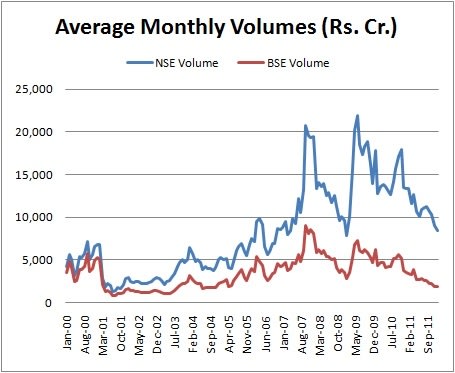
But the irrelevance is mostly to the trading community. Volumes have deserted the Bombay Stock Exchange, for the "better" deal at the National Stock Exchange (NSE). Looking at the "cash" turnover, the gap between the two exchanges has widened from 2000 onwards.
New Image
What has changed since 2000? For one, the derivatives market has flourished on the NSE, with volumes far exceeding the cash markets. NSE started futures on the Nifty in 2000, following up with stock futures and options later. BSE, while having started at the same time with derivatives that replaced the "badla" system, has only recently promoted them. Given that the cash and futures markets are closely related — traders can arbitrage the two markets — it is no wonder that NSE still has four times the volumes of the BSE in cash. Higher volumes means you can buy at a lower "impact" cost due to the presence of more sellers; even those that track the Sensex will buy on the NSE.
But the BSE existed a long time before the NSE. The term Sensex was coined in 1986, but the BSE has existed for over 135 years. There are more stocks listed on the BSE than on the NSE, which was established in 1994. Yet, the BSE lost the battle!
To an extent there were regulatory restrictions — NSE could easily provide terminals nationwide, while BSE only allowed to a slew of sub-brokers, which added to delays and costs.
But the BSE wasn't competitive. Broker cartels were common. Trades were only settled every fortnight, with small defaults and payment crises common. In 1995, the exchange was closed for three days after a default of Rs. 18 crore on a single scrip. The early days involved little technology; brokers would send their agents to the trading pit, when they signalled trades to each other using hand signals and shouting — the "open outcry" model. As an investor, you told your broker to buy a share, and miraculously, you would be given the highest price of the day, and there was really no way for you to verify.
The NSE started with "screen" trading, where all trades would happen in an automated method that matched the best buyer with the best seller, and they offered verifiability where you could check trades and prices. There was a clearing corporation to limit default risk, and NSDL set up to do dematerialized settlement instead of paper. Also, the NSE wasn't managed by brokers; it was owned by institutions and managed professionally, which led to less conflict of interest. From here on, the NSE gained favour even though BSE followed through with similar technology and practices.
The issue is trust: the BSE appears to favour its own. In 2006, a dealing arm of a broker sold eleven lakh shares of Tulip IT Services at a price of Rs. 0.25, on the day of its first listing, with the price having settled at Rs. 185 towards the end of the day. He claimed a typing mistake, costing over Rs. 12 crore — now if this were you or me, we would be asked to suck it up. But the BSE did something dramatic: It decided that all orders executed at less than Rs. 96 would be deemed to have executed at Rs. 171, the average price of the day. What then of the person who thought he got a deal at 0.25 and sold at Rs. 100? He now gets a loss of Rs. 71 instead. This is blatantly unfair — and a loss of Rs. 12 crore is not huge; the seller should have borne it, or the exchange should have covered for it, but it can't be foisted on other traders who participated and assumed that the price they were seeing was correct. (Indeed, an instance of "manipulation" where someone placed a rogue order for Tulip at Rs. 1 per share has been penalized by SEBI)
An ex-BSE-president Anand Rathi had asked for data about who was trading what — information that would benefit him as a broker, and which eventually caused him to resign. Since then, brokers have been removed from senior positions in the exchange, and the management team is now professional staff including a suave CEO. Technology has been upgraded, and there is now complete electronic order matching and verification.
But this hasn't stemmed the rot. Recently, a glitch in algorithmic trading caused the futures market to crash during "mahurat" trading, a special short session held on Diwali for traditional reasons. The decision, once the glitch was found, was to annul all trades in derivatives on that day. What then, if you took on a counter-trade in the cash segment or in the NSE derivatives market? You're left with an open position for no fault of yours.
And the point isn't that there was a genuine issue; the point is that in a fair market, you would assume that:
a) The "rogue" trader should have been penalized to the highest extent possible.
b) There would be much more transparency about what went wrong, how they plan to avoid it in future, and going forward, what the process for "annulment of trades" is.
We have none of this, and if you asked a market participant today, he wouldn't expect it either, because it's the BSE.
Sure, we know the BSE and the Sensex because of the past, but if things are to change, they need to attract investor and trader volumes. For that, there needs to be faith that the exchange will treat investors fairly and not resort to knee jerk reactions like cancelling all trades. Sadly, every incident that undermines trust will result in the Sensex being only an over glorified number, the real money will continue to be in the Nifty.

The School Of Hard Knocks

Many of us desire to make money from the stock markets, because it doesn't seem to take a lot of skill. After all, like a casino, all you need is one good trade. That's what we read about — the success stories of investing talk about how Warren Buffett bought into Coke, or Rakesh Jhunjhunwala bought Titan, or Paulson shorted sub-prime mortgages or such.
While these investors — and many others — have benefited from the huge success of a few stocks, there are thousands, even millions, of other investors who lost much of their money chasing performance. And not just speculating, but even with deep, well researched analysis. A stock that seemed like a steal three years ago is still a steal; they have higher profits, and a lower stock price. In another ten years, they might still have the same stock price. The "value trap" attracts people who think luck plays no role in investing, that all it takes is good analysis.  Value traps are lessons you don't learn about in books; real life teaches you instead.
I attend the School of Hard Knocks, and every time I think I'm close to graduating, I fail the next test. Here are four mistakes I've made and hopefully, learnt from.
Chasing Highs and Lows
On twitter, when I mention that a stock has fallen 10%, I get a quick response — "Is it time to buy?" Usually, it is not — it's a warning sign. But what we like is to have "caught the low" — bought it when the stock was at the bottom. This is unlikely to happen — you may catch a bottom once or twice, but it's like a falling knife that'll slice through you. When Satyam fell rapidly from over 200 to 80 in December 2008, I had decided to pick up a few shares, assuming that it was just a "margin call" or something. The news about Mr. Raju's announcement waltzed in a few minutes later, that he had lied about the company's financials all along. I sold the stock — intra-day — at Rs. 65 or so. It still languishes around those levels three years later. What I thought was a "low" at Rs. 80 went all the way to Rs. 20.
I want to sell the highs too. I held a share called Reliance Petroleum Limited (RPL) which was bought in its IPO at Rs. 60. The stock went to Rs. 240 and I decided to sell. Yet, I felt those pangs of regret as the stock went to Rs. 300. Even with a very good profit — 300% in less than two years — I felt bad that I couldn't make some more?
For the record, I have picked highs and lows; I have bought at the high and sold at the low more often than the other way around.
The Desire to "know".
A friend who had $1,000 in currency asked me if it was a good time to convert to rupees. I said I had no idea. He laughed, and asked me why I was in the finance business if I didn't know. But I honestly didn't know if:
a)      He should care where the rupee or dollar would go, in a one-off transaction, not being a trader
b)      The dollar would move further up — and therefore my friend could get a few more rupees for his dollars
c)       Any prediction would be to simply assuage my friend's need for an answer.
We all wish we could know, which is why astrology is so popular. But we don't.  The markets have asymmetrical information; different participants know different things. An investor may be aware of a problem that you and I don't — and if he sells heavily, the stock collapses; with the information we have, the stock looks attractive, but is it?
I've been trapped enough times thinking that I know more than the market — but more often than not, I've been the ignorant one. In the face of the knowledge that one doesn't really know, what's the right action? Not invest or trade? That would be pointless, because investing or trading, even with incomplete information, can lead to substantially higher returns.
Now I prefer to act another way. I expect this stock to go up. But if it comes down to X, I'll sell, assuming something happened that I didn't know. This is called a "stop loss", but it's more of a "stop the pain of not admitting my ignorance".
The Revenge Trade
And just when I've admitted I was wrong, the stock stops falling and goes back up to new highs. This short-circuits my brain, and I feel like the universe has just conspired against me.
The desire for revenge has made me jump back into a stock, only to watch the temporary move reverse and again come back to hurt me. Usually, such a trade has no logic; it's just a strong feeling that losses in one stock must be recovered from the same stock.
In the school of hard knocks, revenge is an F.
The Perspective: Percentages and Absolutes
Consider the proposal where if you invest Rs. 20,000 in certain (80CCF) bonds, you don't get taxed on that amount. With all sorts of calculations, you hear that you're really investing Rs. 14,000 (since you would have paid Rs. 6,000 as tax on that money, in the highest marginal tax bracket) And then, you get back Rs. 26,000 in five years, making your return 13.2%.
While the 13% is attractive, the entire exercise allows you to earn Rs. 12,000 in five years (assuming the 6,000 in tax saving, and 6,000 in interest).That's Rs. 2,400 per year, or Rs. 200 per month. When you are earning more than Rs. 8 lakhs per year — that's at the highest tax bracket — the amount saved is significantly lower than the joy you feel by hearing "13%".
I have bought stock options for Rs. 100, which tripled in one day. I was overjoyed — 200% in one day. Now let's see: 365 days in a year, 200% a day — that makes me…very stupid. The point here is not just that I can't find such trades every day (and I'll lose my shirt on many of them), it's also that the amount I can invest in options has to necessarily be small, because you can lose 100%. If I invest just 2% of my portfolio on a single trade, and I double my money, the real profit on my total portfolio is just 2%. Nothing to write home about.
Absolutes and percentages both matter; when you get a high percentage return on a single trade, the school of hard knocks tells you to evaluate the overall return on your portfolio instead. You don't appreciate a car that has a great steering wheel if its engine misfires, its headlamps don't work and the seat is uncomfortable. You don't praise one good trade if you have three equal (or worse!) bad ones burning your portfolio.
Perhaps you invested five years ago, when the India story was going strong and they told you, like they told me, that India was the next big thing. Five years have gone, India's GDP and per capita income have doubled, car sales have quadrupled, and yet, markets have returned a miserable 4% per annum, just about beating the savings deposit rate. India's stock market behaves very differently from the rest of India, we learn, as we pass through another year in the school of hard knocks.

Consumer Prices: A Better Inflation Indicator

"Inflation is when you pay Rs. 100 for the fifty rupee haircut you used to get for 25 rupees when you had hair"; a quote I received on twitter. In India, when we speak of inflation, we've never really talked about haircuts. No, I'm serious, stick with me.
The Inflation Index that our country talks about is based on the Wholesale Price Index (WPI), which is a weighted sum of product prices at the wholesale level. That means stuff that you can buy at wholesale markets, such as vegetables, copper, fuel, or even liquor. But it doesn't include the cost of services; the WPI will indicate the cost of vegetables and meat to your favourite restaurant, but it won't add up the cost of chef/waiters' salaries, rent of the premises, air-conditioning costs and valet parking. In the haircut example, they'll note that the scissors or shampoo got more expensive, not that the haircut costs you more.
The world over, what is used is a Consumer Price Index (CPI), which uses a basket of goods that you are more likely to consume and uses end-user prices (not wholesale). CPI is more indicative of inflation that the common man faces. India has taken uncoordinated steps in that direction, with the labour bureau releasing three monthly CPI numbers for Agricultural Labourers, Rural Labourers and Industrial Workers, and the Ministry Of Statistics and Programme Implementation (MOSPI) releasing the CPI for Urban Non Manual Employees (UNME).
Multiple Consumer Price Indexes were necessary, we were told, because the spending pattern of different people was different.
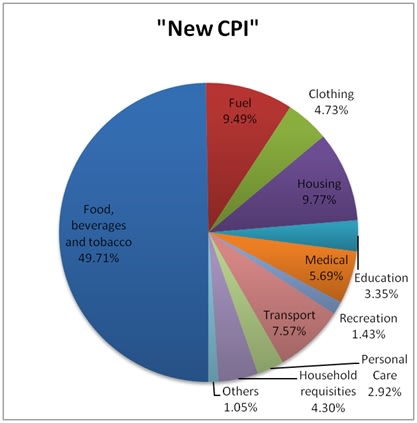
A few years back, MOSPI decided to halt collection of data for the UNME based CPI and prepared data collection for a new index called, with great creativity, the "New CPI". This contains:
Pic1
With the base year as 2010, MOSPI has released data for every month in 2011. This index consists of rural and urban data, with different weights given to each sub-head. The New CPI is envisaged to clear all the confusion among the current CPI indexes; we can only hope that someone else comes up with a "Newer CPI" and confuse the bejeezus out of everyone.
So what has inflation has looked like, when it comes to consumer prices? Since the first data point in the New CPI is January 2011, our first real annual inflation point will be revealed with data for January 2012 (since inflation is a year-on-year change). But we could extrapolate, by looking at December data and comparing it to January.
CPI inflation, thus calculated, gives us an annualized figure of 8.2%. The WPI inflation — the newspaper version — is 7.5%. This is counter-intuitive — food prices are the ones that have reduced the most, and food is nearly half of the CPI. Comparatively, food has a far lower weight in the WPI.
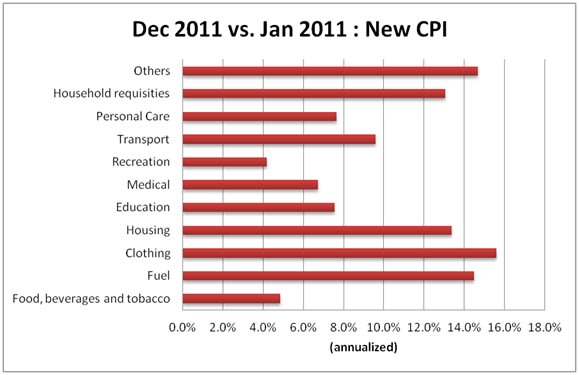
What has happened, then? Let's look at the components:
Pic 2
While food has fallen, much of everything else — from fuel to housing to clothing — has gone up substantially more. If you remove food, the New CPI has gone up 11.4%!
(Even within food, it is vegetables that are down more than 25% from last year, when prices of essential vegetables were shooting through the roof. Take Veggies out and inflation goes to double digits)
In the US, they have a concept of "core" inflation, which is "non-food, non-fuel" — meaning, items that are not heavily volatile. If you calculate that with the WPI, it is only about 8%. But with consumer prices, "core"inflation is 10.70%, a significantly high number. At the core level, prices are sticky — that barber who raises his haircut prices isn't going to reduce it just because shampoo just got a little cheaper.
Think of it this way: when cost prices and salaries go up, barbers will suck up the cost initially. When they can't do it anymore, they'll raise haircut prices. Now even if costs go down, their wages will not decrease — who takes a pay cut voluntarily? — so the consumer's price remains constant. This is "sticky" inflation and one of the most difficult to reverse.
CPI measures inflation you can actually see. Rents are going up. Wages — not just yours but also those you hire, are shooting up. Clothes, restaurants, fuel — all up. The inflation that we saw in the wholesale prices a year or so back (inflation at the primary and wholesale level was nearly 20%) has now moved into items where you and I can feel the pinch.
Still, it's not useful to emulate what the west does. The US attempts to mask its CPI-based inflation by making adjustments that distort the CPI itself. It uses a substitution effect — stating, in effect, that if meat prices go up too much, people will substitute it with chicken, so we'll use the lower of the two prices. They use "hedonic adjustments" to show, for example, that a computer has become cheaper even if you pay the same price, because you get more hard disk space today. These are vaguely justifiable changes, but very wrong in the context of calculating how the common man hurts. While the objective of doing such a thing is unclear, most people believe they are used because they make GDP data look better. Luckily, our tinkering with four different CPIs has kept us from such adjustments.
The CPI is, in general, a better indicator of inflation than a wholesale price index; the rest of the world also thinks so. We have a new index, and let's hope they regulators decide to use it to gauge inflation as it really is, and that index creators don't get ideas to distort the index so that it makes other data more appealing in comparison. And to address the issues with the WPI data, let's also hope that CPI data is properly maintained and promptly updated.
Maybe I'll be able to keep my hair on, just for that haircut.

Why is India’s fiscal deficit so high?

While we are battered with news about abandoned babies, victories and then losses for telecom firms, elections in UP and surging stock markets, it's useful to note the quietly released data on the fiscal deficit that are seriously alarming.
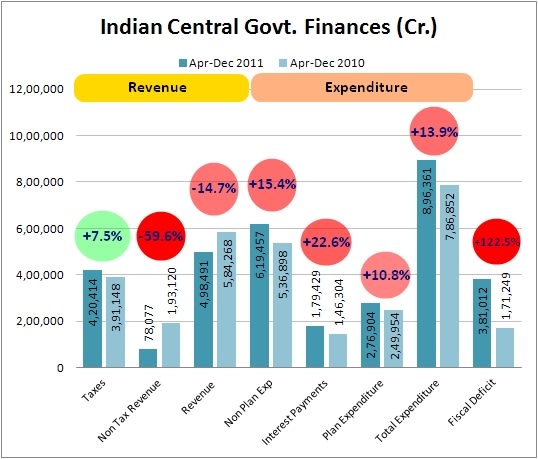
The Comptroller General of Accounts (CGA) has reported that the government revenue, from April to December 2011, is 15% lower than the same period last year. Meanwhile, total expenditure is up 14%. Higher spending and lower revenue point to a fiscal deficit that is more than double last year's figures, till December.
Indian Central government

Advance Taxes Are Not Enough

December, was when corporates (and individuals) pay another chunk of advance tax. This should have bolstered government revenues, but it seemingly has not. Total tax revenue in December, net of what was paid to the states, was Rs 99,944 crores, just 5.3% above the previous year. For the April to December time period, tax collections are just 7.5% higher.
Consider that India's Gross Domestic Product has grown 16% in "nominal" terms — that is, before inflation is removed. Government tax revenue should grow at the nominal rate (at least), but increasing inflation has eaten substantially into profits and thus, to taxes.
Meanwhile, government expenditure is growing at nearly 14%. No wonder the deficit is now at Rs 3.8 lakh crore, which is already more than 90% of the budgeted deficit for the entire year.

Lower Corporate Profits

Analyzing the December quarter results which are being announced now tells us that corporate profits, from the 400 top companies, have fallen 1.5% from the same quarter a year back. The September quarter was also a declining number. While revenues have grown 26%, expenses have grown even more at 32%. A lower corporate profit number doesn't just cut directly from government revenues, it makes valuations of their stocks lower (and the government owns a large chunk of PSUs).

The Lack of Enough Non-Tax Revenue

Last year, a bulk of non-tax revenue came from selling the 3G and BWA spectrum. This year the government expected to sell equity stakes in public sector companies like ONGC and BHEL, which has not yet happened largely because the government believes the market prices are too low.
The government has tried innovative means of revenue. It has asked government owned companies to buy back their shares with their surplus cash. Nearly 30,000 cr. worth shares of large companies like L&T and Axis bank lie with SUUTI, a special purpose vehicle that was created when US-64, a mutual fund, was bailed out by the government. These could be sold, but prices will drop if the news is public, so the idea is to sell the shares into another SPV and use accounting magic to make the non-tax number. The most innovative, perhaps, was to attempt to charge Vodafone with an income tax order of more than 8,000 cr. after they bought the telecom company, Hutch; the Supreme Court has since ruled against the government.

Bailouts and Oil Subsidies

While expenses are up 14%, they don't include certain large ticket items. The oil deficit — the under-recovery because we price diesel, LPG and kerosene below market prices — is now 97,000 crores, and is likely to grow to about 125,000 crores. A good portion of that will have to be financed by the central government. There is an increase in the acquisition prices of food from farmers, there's more fertilizer subsidy, increase in payments to NREGA, and so on. For the last quarter, there are also bailouts of Air India, additional capital to the public sector banks and the whole election process to keep expenses higher.

Borrowing Impact: Credit and Inflation

Why are deficits bad? After all, what the government can't earn, it will borrow from the markets. What it can't even borrow, the RBI will print. The RBI is using Open Market Operations to buy bonds on the same day the government is issuing new ones — effectively printing money to fund the deficit. This is also what is happening in the US with the Federal Reserve buying bonds, in the UK and Europe, and in Japan. Then why is a deficit a problem?
The often stated problem is that money-printing at this level will stoke inflation. Effectively, to fund a deficit of 600,000 crores, the RBI might need to print 200,000 crores. That is an increase of nearly 15% in our money supply, and if you add another 10-12% from other ways, we'll be expanding money supply by one-fourth every year, a sure shot recipe for higher prices as the money chases the same goods.
Those other countries would love some inflation — but we're dealing with a lot of it, with inflation in double digits as recently as October. Germany and Zimbabwe have seen events of hyperinflation, when inflation was more than 100% a day. That was largely because of the unlimited printing of currency, and the inflationary spiral acts very fast if you cross a boundary. The RBI's actions may "bailout" the government borrowing programme today, but given that they have a strong stance against inflation, RBI is equally likely to increase rates or take up other measures if inflation goes back into double digits.
Increased borrowing also crowds out private credit — if the financiers can lend to the government at a good enough rate, they won't lend to you and me. And eventually, we are a private led economy (the government is less than 25% of our GDP) so the lack of private growth will hurt everyone.
High deficits are unsustainable, as Greece and Portugal are finding out. Regardless of how things might seem, and other news that seem to be grabbing headlines, now is the time for tough decisions. We may need to increase taxes, reduce expenses or find alternate sources of government revenue. We may need to forego some of the populist measures our government pushed down our collective throats. But will this happen or will we run to the new deity in town, the printing press?

When investing, it’s all right to be wrong

In 1973, the Kreditbanken (bank) at Norrmalmstorg in Stockholm was attacked by robbers, who held bank employees hostage for five days. After the drama, it was evident that the hostages sympathized with their captors, even though they were held against their will. The situation is now considered an academic study — the Stockholm Syndrome — where people get emotionally attached to people who obviously try to do them harm.
More apparent, perhaps was the case of Jaycee Lee Dugard, who was held for 18 long years — from 1991 to 2009 — but got so emotionally attached to her abductor that she even helped him in his business and met customers. Being an unwilling hostage, or in other cases, just being in an unwelcome situation with no way out, makes us rationalize in favour of our position.
Less dramatically, we become hostage to our own opinion. We simply can't let go of what we believe is "normal", even in the face of facts. If your blood tests show you have a high cholesterol level, your immediate reaction is to hope the problem will go away on its own, or imagine that the tests were incorrect. A person abused at work — sometimes with lewd suggestions — will initially justify it as harmless workplace banter. The victims of a drunken driving accident will side with the driver saying how good a driver he "usually" is. We simply don't want to see it, even if we know it.
In the financial world, our beliefs are tested often. In 2011, the markets fell over 24%, with the situation in December as dire as it could be; the government was running out of money, industry was slowing down, inflation was high and everything looked bleak. In January 2012, we saw the Nifty and Sensex rise 12%, with no apparent improvement in any of the other pieces of data. This rise has bewildered most analysts, who continue to believe, at every stage, that the market will reverse back down. Consistently, nearly every day, the market sees a rise, but the sage opinion is that this is a fake rally, and that this will come down like a ton of bricks.
It might. The analysis may be spot on, that the Indian story has hit a pause button and not worthy of very high valuations. But at some point, we need to admit that the tide has turned, and prices keep moving north. Our conviction is worth the paper it was never written on — but we carry the weight of it on our shoulders altogether too long. Such irrationality can cost money —a trader that stays short despite a stop loss being broken, almost in anger against such a furiously rising market, continues to lose until eventually giving up. An investor who decides a stock is great and watches it fall, keeps buying until the stock becomes an abnormally large investment, and later feels serious regret when other stocks do better.
If you strongly believed in the Indian telecom story, it was lost on the stocks. From Bharti Airtel to Reliance Communications, the stock prices are way lower than their highs in 2007. We have more air travel than ever before, but airline stocks are in the doldrums. India is spending an enormous amount of money on infrastructure, but the road-builders and power-plant-owners are scraping the bottom of the barrel in the markets. Yet, the question I first get when I say all this is: "Good time to buy?"
The correct way to deal with markets is to expect to be wrong. You have to consciously look for information that counters your thought process. If banks are supposed to be in trouble, then look at their positive results, and look at how strongly the RBI is supporting the system. If buying IT companies on a falling rupee sounds exciting, consider reports that customers are quite aware of the fall and demand corresponding concessions, which they don't reverse easily as the rupee recovers. If you like to buy stocks when they make a new one-year-low, test out how many times you would have made money investing in a broad array of such stocks in the past. (I have checked, and results are horrendously negative at a portfolio level though there are a few that will shine)
It's not easy to stay fluid and keep switching sides as the tide turns — society values loyalty much more than rationality. Being wrong is okay, but staying wrong is evil; in the markets, we can't get married to our opinion.

Why You Shouldn’t ‘Invest’ in Life Insurance

The three reasons people buy insurance is:
a) To save tax.
b) As an investment, to make a good return on their money.
c) To feel good that one has some insurance or to get rid of that pesky uncle who keeps mentioning it.
The fourth — and perhaps most important — reason to buy insurance is to let your family be financially secure if you die. This is the only reason anything should be insured. Car insurance gives you money if your car has an accident, and covers costs for people you might injure. Home Fire insurance covers the damages in case there's a fire. You pay every year, and you're happy to not have to claim (because it means you've not had an accident or a fire!); and at the end, you don't get your money back.
Not so with Life insurance. The most policies bought are for the purpose of saving or investing, not for insurance. And that, further, is because Life Insurance is hardly ever bought, it's sold. The sellers get a fatter commission when they sell you a "saving" product, so you don't ever get to see the real insurance. "Pure Term" insurance is the only real deal: where your family gets paid if you die, and your premium is lost when you don't). Anything else, usually called ULIPs, Money-back, Endowment or Savings policies, involve a small amount of insurance and a higher degree of saving.
Even if it sounds like killing two birds with one cheque, you shouldn't mix investment and insurance — because you don't get enough of either. Take a 35 year old with a monthly salary of Rs. 50,000 and expenses of, say, Rs. 30,000. The minimum insurance expected would be about Rs. 1 crore; the idea is that you need your family to live another 40 years off the money, at a current return of around 8% risk-free and expenses rising at an inflation of 6%.
The cost of a "term" policy of Rs. 1 crore could be between Rs. 15,000 and Rs. 30,000 per year — or Rs. 1,500 to Rs. 2,500 per month, easily affordable. But agents find such policies unlikely to give them enough commissions, and they know that if they try, they can get the customer to pay Rs. 10,000 per month. A "ULIP" or an endowment plan with Rs. 10,000 per month as premium might give the buyer just Rs. 10-15 lakhs as insurance cover (typically 10x to 15x annual premium); a vastly inadequate sum compared to the 1 crore the person needs! But the seller persists and gets his way, largely because the customer has no idea how to work the metrics, and gets a feeling of happiness that there is some insurance and investment, when there really isn't.
In the longer term, I expect the tax-benefits of insurance to go away. There are two areas to this — first, insurance proceeds of any sort are tax free, even where the insurance cover is next to nothing and the product was primarily a product to save money. The second is a tax deduction on the amount invested every year, subject to an upper overall limit. Both are under threat in the longer term, as the government tries to find other means of raising revenue to meet increasing deficits. Additionally, it's untenable that long term savings of one nature — insurance or PF — are non-taxable, but buying long dated government bonds or (non-equity) mutual funds makes you pay tax on the gains. Lastly, if the government introduces a tax for inheritance (a proposal under discussion) then life insurance with a large one-time payment becomes an easy way to avoid such a tax; it is quite likely that the government will then plug the loophole by making "insurance as an investment" liable to tax.
In a decade, we are likely to see the tax-free exit status of many schemes vanish or dwindle, or at least force you to invest in low-yielding-annuities if you want to retain a tax advantage. Put another way: To assume that if I buy, I will not be charged a tax on exit even after 20 years is fraught with risk.
The last problem is that of complexity. Insurance products are incredibly complex, despite their heavy regulation. Financial products are typically of two types —high-risk, where the returns cannot be predicted in any reasonable manner, and low-risk, where the return is either guaranteed or specified (the risk is in whether the seller will go bust). Equity is a high-risk proposition, while fixed deposit and other debt options are the second. Insurance products provide a mix-and-match, with some products giving a vague guarantee with an additional potential upside (like 50% minimum guaranteed return or highest NAV in 10 years). Then they give you weird terms — you pay for five years, you can exit only after 10 years, the guarantee applies on the first seven years' NAV, and so on. And then, if you die, the insurance might pay out the guaranteed amount, the "sum assured", the amount that your investment has grown, or the lowest of all three. By the time you understand the terms and are able to calculate your real return, you might find it ridiculously low (if your brain hasn't turned to jelly). A case in point: the real return on that "50% in 10 years guaranteed" cases is just short of 5% per year, which is unacceptably low, even if you consider your taxes saved.
Most people give up before they reach the "real return" calculation — which is why insurers can easily stuff charges into such policies, knowing that if someone is silly enough to invest with a 5% real return, he won't even know that they can take a significant chunk of money as commissions. While we have seen charges that added up to 50% to 60% of the first few years of premium, even the lower 10% charges we see today are massive compared to the 1% to 3% that are charged by, say, mutual funds.
With the problem being that such products are sold — and sold hard — to customers, what we see in the Life insurance industry is more of industry and less of insurance. And as it increasingly sucks the blood out of unwary buyers, less of Life as well.

What we left on the table

As the time closes in for the Budget in mid-March, the question on the mind of everyone is: will we get a lower tax rate? For most of the people watching, the budget doesn't begin until the finance minister says "tax slabs" and ends immediately thereafter. But the underlying assumption for lowering direct taxes is that a lower tax rate will result in greater compliance with more taxpayers coming forth to pay; the overall result being that tax collections increase.
While this has happened in general, the tax collections have been very low this year, despite large slab changes in the last budget. The total tax receipts have gone up only 7% till December, making it a pretty bad year — only 2008 and 2009 were worse. It is thus likely that the government starts to take a hard look at where they must cut down the deficit, and they provide an estimate of "Revenue Foregone" under various proposals.
Let's take a look at the "losses" that the government faces through lower taxes or tariffs on various elements. And more importantly, if it looks likely that some of these

Lower Excise Duty : 187,000 cr.

The current tax laws provide for lower excise duties if a company is in a specified area (like Himachal Pradesh, Uttarkhand or the North East). And then other products get a reduced excise duty - all of which have an estimated lower revenue of Rs. 187,000 cr. Sadly, we don't have a further breakup of the taxes foregone.
Much of the lowering of excise duty was due to the financial crisis of 2008-09, from which we have recovered handsomely. The reasons for the exemptions to remain are weak, and I expect many of these excise duty exemptions to be removed, and the duty restored to the levels pre-2008.
In the light of a GST that may only happen next year, it's time to get the rates of excise/VAT and service tax aligned anyhow, which will only mean that excise rates will go up.

Lower customs duty: 200,000 cr.

On diamonds and Gold: 48,000 cr.
On Crude Oil: 40,000 cr.
Customs duty on Crude was a low 5% (since removed as oil prices went up again) and that has resulted in a loss of 40,000 cr. — now some of this loss is notional, as some of the crude we import is refined and products are exported; however we will learn that the profits on such refine+export models is further untaxed through export promotion schemes.
Many of the diamonds we import are re-exported, but we retain most of the gold we import. Gold imports are difficult to change — a higher duty on gold imports makes it more attractive to smuggle in gold (a big thing in the 80s). However, India has "doubled" the import duty for gold to Rs. 570 per 10 grams (from Rs. 300) which is more aligned with the prices today.
Further the import of cotton loses India 2,000 crores in duties, and importing ships and aircrafts a further 3,000 cr. Removal of exemptions on electrical machinery — a demand by the large electric manufacturers in India — would have given us an estimated 10,140 cr. of revenue in 2010-11. We are likely to see customs duty changes to gather more revenue this year.

Export Promotion: 54,000 cr. in duties, 19,000 cr. in income taxes

India offers exporters certain exemptions — from duty free imports, to zero income tax on export profits. Just duty concessions to various kinds of firms denied India an income of 54,000 crores, though it is unlikely that so much would have been imported had there been full customs duty.
Special Economic Zones (SEZs) have been created for exports and companies will pay no taxes on profits earned here; reduced or no income taxes apply for companies that export certain kinds of items (like STPI for software). With the Minimum Alternate Tax, these companies have to pay about 20% tax anyhow; this might not be considered in the calculation that such export promotion schemes have lost us Rs. 19,000 cr. in taxable income.
Such promotions have a cost — one of the reasons regional language software in India is difficult to come by is that software companies focused on exports rather than serving local needs. After all, why sell locally and pay taxes on profits when you can sell abroad and pay nothing? This is the downside of making an Infosys or a TCS.

Accelerated Depreciation: Rs. 35,000 cr.

The Indian government supports renewable energy by providing a higher depreciation for wind energy projects, upto 80% a year. While this provides for greater investment, the loss that the government incurs is fairly large, for a return that, till now, seems much lower (at least for wind power).
While it's necessary to keep incentives going, it is retrograde to concentrate them in certain areas. Renewable energy through wind power skews incentives towards just that solution — certain others (like natural gas, nuclear or hydro) might give just the same level of "clean" per kilowatt generated, and need a broader programme.

Section 80C: 37,424 cr.

You get a tax exemption of Rs 100,000 on investing in certain kinds of savings instruments, buying a provident fund, buying insurance, paying your housing loan principal or for your child's tuition fees. This costs the government a whopping 37,000 cr. in terms of taxes you would have otherwise paid. This amount is nearly as much as is used by the whole NREGA program every year.
Since the upcoming Direct Tax Code (DTC) has no exemption system like it, it is likely that the 80(C) structure will change, and reduce the effective savings rates.
And to end:
The government provides a tax exemption to contributions given to political parties (Section 80GGC). This has cost the government Rs. 191 crores, which would have helped run parliament for about 100 days — or the number of days it wasn't allowed to run because of parliamentary disruption. Essentially, you — the taxpayer — have elected your MP who disrupts parliament and costs it money that could have been recovered by taxing the person who gave the MP the money so he could campaign and get elected by you.
But I don't expect that to change.

Banking On The Ombudsman

Have you been hassled by credit card bills even after you have had a "full and final settlement"? Did a bank give you a bill for a credit card you don't even have, and then deducted the amount due from your bank account before asking you? Have they changed your interest rate without informing you in advance, or giving you an opportunity to refinance elsewhere?
You can complain, without having to go to court. You must, of course, complain to the bank first, and only if the bank is unable to resolve your issue within 30 days — or take a decision that you think violates banking rules — you can go to a higher authority, the Banking Ombudsman.
The Banking Ombudsman (BO) web site allows you to directly lodge a complaint online. (Sadly only 13% were given online, and 14% by email last year — 73% of applications still came by the old method of letter or post-card) You will need to go through the documentation to find out exactly what section your complaint applies in, but the process is well detailed. If the BO decision is not to your liking, you can further appeal to an Appelate Authority.
Some of the "exemplary" cases (read the annual report) give you an idea of how a hopeless situation can be rescued by a process that doesn't involve the legal drudgery that the regular courts have become. In one case, the bank lost all original documents of a house, given as collateral for a housing loan. The bank then decided to give "certified copies" of the documents instead. The BO ruled that original deeds were not replaced by certified copies, and the bank was ordered to pay Rs. 25,000 for a deficiency in service, and also to advertise in newspapers that they had lost the originals. (Such ads are usable as evidence, in case there is ever a litigation involving the property, of the chain of ownership)
In another case, a customer who applied for a loan later decided against taking it; the bank issued the loan anyway, to a person with a similar name. When that person defaulted, the bank used the police to harass the original applicant, who hadn't even taken the money! The ombudsman provided a compensation of Rs. 100,000 — a stiff amount, but easily justifiable considering the damage caused and the ridiculous nature of the case.
Many cases have been about credit cards; a customer was given statements for a card that was never delivered, another whose CIBIL data was not updated for two years despite having settled the bank claim, and yet another who was harassed without having a card from a bank with the excuse that his name was similar to another defaulter.
One common complaint now is that interest rates on loans are no longer "fixed". Even fixed rate loans carry a reset clause every few years (which means it is totally silly to go for a fixed rate loan). A customer who complained of one such reset was told that the reset clause was perfectly valid — this serves as a basis for further such cases.
The BO seems to have worked with insurance players as well. In one case where a customer was "mis-sold" an insurance policy as a one-time premium rather than a regular premium, the BO convinced the insurance company to refund the premium of Rs. 1 lakh . (You must note, however, that it was the customer's education level and monthly earning that justified the action — it's unlikely that the BO will take action if you are smart enough to have read through these documents. In essence, you don't have an excuse if you're well educated)
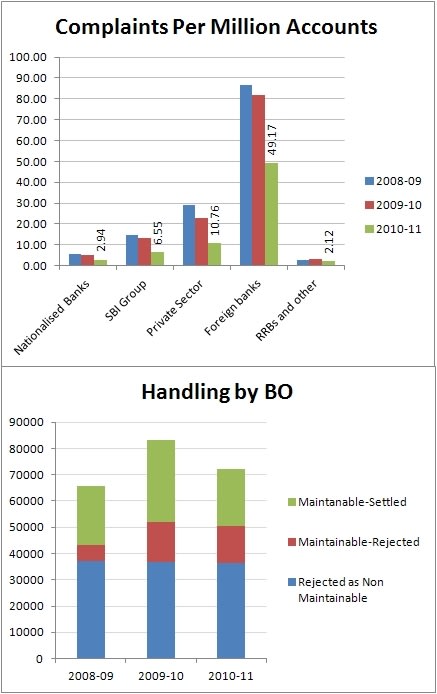
But these really seem exemplary. Of the 72,021 complaints received, about 50,000 — or 70% - were rejected. More than 51% of complaints were rejected on grounds of them being "non maintainable", that is, they were either incomplete or didn't come under the Ombudsman act. Even of those that were maintainable, 13,952 were rejected. What we can learn from this is that it's important to keep copies of all communication and get things in writing, so that if there's an issue later our complaint doesn't get rejected for inadequate or incomplete documentation.
You might think that private banks are better because of service, you might be surprised that the number of complaints per million accounts, for private banks is far higher — by a factor of 3 — than the good old public sector ("nationalized") banks.
Banking omnibudsman
While the ombudsman has done a good job, the current reach is too little (only 15 locations where the ombudsman is present) and it is highly unlikely that bank customers are aware of the process of appeal against deficiencies in service. Banks are a highly regulated entity and must adhere to strict process. For instance, they cannot just recall a loan from you because they want to; they cannot refuse to give you money that is yours; and they pay a huge fine (Rs. 100 per day) if your account is debited after an ATM transaction but the machine doesn't give you money.
These rules aren't known by too many people, and we can't expect bank officials to tell customers where they can complain (since the bank employee is possibly at fault anyhow). As more people become aware, the volume of complaints — "maintainable" or otherwise — will go up, and both the Ombudsman and the individual banks will need to up the level of service.

Building affordable housing by curbing bubbles in real estate

More than 2.6 crore houses are required in India, with more than 99% required for the economically weaker sections of society. To achieve this, the government has provided substantial impetus for housing, and some of it is in the wrong place. However, housing is an important part of the budget and GDP activity. If we need to provide lower cost housing, we actually need to lower the cost of housing.
That means we have to reduce the "bubbly" nature of the real estate game and reduce the concept of property to a functional object rather than a store of wealth. This can be achieved by switching tax rules to disincentivize speculation in the property market, and instead, incentivize homeowners that actually live in the houses they buy. The other objective of the budget is to increase revenue — a need never seen quite as important as in the forthcoming budget, when our deficits will be gargantuan and the government will want to increase tax revenue.
Today, a tax cut for interest paid exists upto Rs. 150,000 per year, for the house you live in. At the rate of 11% a year for a housing loan today, that translates to a loan of just Rs. 13.6 lakhs, and if you consider the 20% down payment that you must put, for a house valued at about 17 lakhs. . That would buy you only the tiniest house in Delhi or Bangalore, and a matchbox in Mumbai. If people pay more for a house, they will pay more interest than they can deduct from their taxable income. Since the RBI gives preferential treatment (discussed later) to housing loans less than 25 lakhs, and the finance minister might find it justifiable that the interest exemption be extended to Rs. 250,000 per year.
But if you buy a second house, what is the maximum amount of interest you are allowed to deduct? Answer: there is no maximum. The Rs. 150,000 only applies to the house you live in; if you buy a second one and expect to rent it out, you can claim ALL the paid interest as a deduction. This, you might argue, makes complete sense — after all, renting out a house is a business, and interest is a legitimate cost of running that business.
Not quite so. In the current tax rules, you already get a 30% deduction from rent earned — no matter what magnificent amount you receive — as a deduction for sundry expenses. Hardly any house that rents for Rs. 20,000 per month has expenses of Rs. 72,000 per year (landlords might be lucky to spend that amount in five years!).
Secondly, the devil is in the often missed details. In India, rental yields are very low — of the order of 2-3% of the property value. So if you buy a house for 1 cr (Rs. 10 million) you might only be able to rent it out for, say, Rs. 20,000 per month, or Rs. 2.4 lakh per year. Net of the above 30% deduction, the real "income" is only Rs. 168,000.
But the interest cost on a loan for the same house, at 11% a year, may be as much as Rs. 900,000. (Assume the loan is for Rs. 80 lakh, at 11%).
The difference — of more than 700,000 - is a loss from house property — a loss that you can offset with anything, including salary income. This sounds fair — after all, I lose money somewhere, and I make it elsewhere, these balance out, right?
Wrong.
Our tax laws do not allow "balancing out" of losses under any other kind of income with each other. That means, if you make losses in short-term trading of shares, you can't offset that loss with your salary; you have to wait till a subsequent year gives you profits in share-trading. So you'll lose money on the trading, and also pay tax on the salary. What losses you make in one "head" of income cannot be offset by income in another head. The concept also applies for losses made in proprietary or partnership businesses (such as for doctors, lawyers or professionals) or speculative losses.
This rule miraculously does not apply for housing. Losses in property can be offset against income in any other head. This is a grossly perverse incentive in favour of buying a second property, which only causes speculation in real estate and increases costs for primary homeowners.
The Finance Minister must remove the 30% arbitrary expense deduction clause, and make any deductions based on actual expenditure only. Secondly, losses from housing property should not be able to offset gains in any other "head"; so salary income cannot be offset by losses made by investing in a second property. This would bring speculation in housing in par with starting a personal business, which is a more fair proposition with the advantage of curbing bubbles in real estate.
The third kind of incentive we provide is "priority sector lending". The RBI allows banks to allocate lesser capital to loans that are provided against houses that cost less than 25 lakhs. This is misused by builders, who convince customers to take a loan three years before the property is constructed and promise to pay the interest; the catch here is that if the builder asked the bank for a loan, he wouldn't be a "priority sector" borrower and therefore, would get a much higher interest rate for the money. This loophole gives builders access to money at lower rates, and instead of using it to deliver faster they create more "under construction" properties to gather more money. Additionally, such a scheme, where the builder pays a borrower's EMI, is likely to be judged as taxable income for the borrower; since it is his expense that is borne by the builder. It may be in the government's interest to clarify that builder-subsidized-EMIs will be treated as income for the borrower, and thus curb another unnecessary perk for home prices.
We are among the only countries in the world that subsidizes the principal repayment of a housing loan, under section 80(C). The Direct Tax Code, applicable only from 2013 if the Parliament functions long enough to pass it, will remove this deduction. But I expect the Finance Minister to consider removing it this year.
Finally, there is the capital gains tax-saving incentive. If you make taxable long term capital gains of any sort — by selling shares or government bonds, selling gold or selling your property, you can buy a residential property with the proceeds and not pay that capital gains tax. Since the only other comparable avenues (of saving capital gains tax) are buying NHAI and REC bonds at 6% interest, we are equating buying a house with investing in the country's infrastructure. This is an overreach that requires correction.
With all the skewed incentives, the price of residential real estate has gone up substantially over the years. The cost of cement, sand and concrete have not changed so much, so the price rise has little to do with the cost of building the house. It has everything to do with the "feeling" that real estate prices must go up; but it is in the nations interest that we don't let it get overboard. If there was anything to learn from the crisis the west has just gone through, it is that housing creates enormous bubbles. It is better to think of a house as a place to live in rather than its current market value; but the lobby of builders, brokers and real estate speculators has a strong representation in government and they will fight policy reform every step of the way. Over to you, Finance Minister.

The Budget Has Moved Stock Markets 1.08% on Average

In the run up to the budget, and a few days after, the markets have reacted differently. The average budget day move, since 2000, is a tiny 1.08%. But that masks the volatility that the budget has seen, in both directions:
Bud Stock Moves
In the last two years, budget days have been incredibly benign and positive. In those budgets, we have expected, and got, tax cuts in various measures. In 2009, the expectations ran away, perhaps, as the markets toppled after both the interim and final budget presentations.
But are budgets usually positive? If you look at the budget moves from one month earlier to the previous day of the budget, and then onwards to one month after, is there a clear picture that emerges?
Bud And Stock Markets
There is no single direction the market has taken after the budget, based on its trajectory before the budget. In 2001, while the markets moved up more than 4% on budget day, they ended up falling 15% more in the subsequent month. The 2006 budget saw a flat budget day, and a benign period prior, and then the market zoomed up after the big day.
This isn't to say the budget is the only event that influences the market, but it creates a substantial impact. Policies that might be taken positively are:
  • Measures to increase foreign participation where there is interest
  • Investment in infrastructure (Roads, Power, Water)
  • A sincere attempt to reduce fiscal deficits
  • Rationalization of taxes; a tax cut surely helps.
  • Transparency initiatives that make it easier to do business
How much of these can we expect in 2012? While there have been proposals to increase investment limits in areas such as airlines, the big proposal to allow FDI in multi-brand retail has been jinxed by the political play in parliament.
Power projects face a massive problem in coal supply that can't easily be addressed; roads are being built, albeit at a slower pace than expected, with state governments playing truant in connectivity. There is no water policy of any sort and earlier attempts to create a river linking infrastructure ran into political trouble. The infrastructure industry has been given sops (investment linked tax cuts), guarantees (through pre-defined supply/revenue-share agreements) and easy credit (personal income tax deductions for investors in their bonds, higher priority in bank credit and so on) . If the Finance Minister can find a way to excite us all about how India will have great infrastructure, it will have to beyond the obvious.
We have the worst fiscal situation in about five years, with the deficit going up, inflation remaining stubbornly high and tax collections slowing down. We have not realized quite as much revenue from the selling of stake in public companies — the most recent, like ONGC and NTPC, have had to be "rescued" by the long-term funds in publicly owned insurers. With markets
Tax increases will have to be done, and some of it will even be justified: for instance, service tax was at 12%, brought down to 10% in the face of a global economic crisis. Now that the crisis is behind us, it might make sense to go back to 12%. But going by the vehement opposition of certain parties that currently run West Bengal, any rise in the tax rate is going to be a big challenge, at least politically. The one change that might give markets some joy is the removal of Securities Transaction Tax (STT), a long standing demand of those that play stocks on a daily basis.
Nevertheless, it will be a challenge to create a budget that excites stock markets, and increasingly, politicians are looking towards market responses as a vindication (or rejection) of their policies. This is a dangerous trend, as stock markets are given to panic and euphoria without thinking. An innocuous statement can be interpreted as a major policy change by the over enthusiastic anchors on TV, which will then spread like wildfire even as everyone calls it breaking news. (what news is not "breaking" nowadays?) The result: markets move violently in either direction, and we see a barrage of interviews, interrupted-sentences, incomplete debates and needless posturing before there is clarity.
Heart of hearts, we all want a blockbuster budget: one that reduces our tax rates, reduces the fiscal deficit, encourages foreign investment, increases exports and provides money to unemployed rural workers. I think we'll end up getting only one or two of the above, if we're lucky.