Tuesday, 15 January 2013

Of Losses and Low Prices

Is "cheap" good, when you're making losses? In general, people like cheap. As in "inexpensive", not "shoddy". Prices can get lower for many reasons. Competition can force price cuts — either you compete or customers leave you. You can get greater productivity — producing more at the same price means you can charge lesser. You can lock in the price of your raw materials and retain customer prices at the same level.
Let's look at a few industries where, over a long period, prices haven't changed or have actually come down.
The most obvious is electronics. About 15 years ago, I paid Rs. 65,000 for a mid-level computer, and I'd probably pay about Rs. 25,000 today. Prices of chips fall, even as they add more computing power. Even as prices have dropped, profits of semiconductor companies have stayed high; volumes and efficiencies more than made up for increase in raw material costs or labour.
The car market has also managed to maintain prices, for the most part. A Hyundai Accent (one of the cheapest sedans in India) cost about Rs. 520,000 in 2005, and continues to cost around that much today. (Delhi prices) Again, carmakers aren't entirely miserable; Maruti has dramatically increased profits through greater volume.
While food costs have increased, the cost of staying in a hotel in a holiday location has largely remained the same. City room prices have gone up but that's largely due to business travel. Still, hotels have managed to retain margins for the most part. Some of the impact here is competition, but it's also that volumes have gone up and costs are spread across more customers and room-nights.
But this hasn't applied to a few industries which seem to be in the limelight today. Airlines have been losing money, even though their prices continue to be ridiculously low. Not that I'm complaining, having recently paid the same amount for a family of four (one infant) as I did for just one ticket 10 years ago. Airlines have almost no productivity benefits to provide — the aircraft manufacturers have so much demand they won't cut prices, labour costs more where good staff is in demand, and fuel costs are market determined and taxed to the moon and back. Regulators, too, step into every piece of the pricing process — recently, the airline regulator barred airlines for charging for pre-assigned seating, for instance. Even if there are more flyers than ever, airlines are simply not turning a profit. The massive capital required to buy planes, or the high operational costs (parking costs, landing fees, rent etc.) are either impossible to reduce or too difficult to influence. In addition, you have the taxpayer bailed-out Air India that seems to be able to make endless losses and still continue to get aided by the taxes collected of our sweat and hard work. If they charge less, everyone must follow.
Telecom companies must pay government mandated (or auctioned) fees for spectrum and for licenses, and yet, their average revenues per user have been going down. Some carriers show user revenues as low as Rs. 100 per user per month. These customers simply don't exist at higher price points — raise prices, and you'll find people start migrating away or using landlines instead. The high costs of supporting voice is expected to be made up through the more high-end data charges, but the 3G auctions have driven up the price of data packages so much that they're unaffordable except for the urban rich. With infrastructure costs mounting, from tower rents to equipment, and employee salaries rising, there's very little room for cost cutting, other than large layoffs and silent retrenchment that the industry has been seeing in the last year.
Oil-marketing companies that have been giving us substantially cheaper fuel than the market should otherwise allow. Oil companies are losing Rs. 512 cr. per day on the under-recovery of costs in diesel, LPG and Kerosene. Fuel is not cheap — in Bangalore, we pay over Rs. 73 per litre of petrol (which is equivalent to $5.3 a gallon), a large portion of which are state and central taxes. But oil companies still make losses because the real cost to us, the consumers, needs to be higher; and in 2011-12, they have lost over 138,000 cr. (Rs. 1.38 trillion).
In other industries such as online retailing or "deals", players attempt to gain market share by selling at a loss. A restaurant might attempt to give away meal coupons at a loss in the hope that patrons will continue to visit it even when there's no coupon. But if it turns out that most "new" customers wouldn't have paid the higher non-coupon rate anyway, the strategy fails. Other companies lose money on one product to make profits in another; shaving razors are sold at a loss that overpriced blades will more than make up for, printers are made cheap so you'll buy the expensive ink replacements, and newspapers are sold cheap so that you can see all those advertisements instead.
During the dot-com boom, losses were considered par for the course, and companies were valued using other metrics like eyeballs, page views or meters of cable laid. It got so bad that if you actually made profits people wondered if you weren't trying hard enough. That situation had an unhappy ending, but it was because of those investments (and losses) that the world got cheap fiber, as the current companies bought it for fire-sale prices when the loss makers went bankrupt.
The losses in airlines, telecom and oil will see different endings, not all of them happy for the survivors. My take: Oil prices will have to go up in order to curb demand, since you have nothing great in terms of alternatives or technological progress in the field. The existing telecom setup will change as some of the current companies die and sell their infrastructure cheap to new players, who will then be profitable at the same price points. Airlines will make losses till kingdom come, because it's that glamorous industry where no one ever seems to make money on a sustained basis anywhere in the world. The old joke goes:
"How do you become a millionaire?"
"Begin as a billionaire and buy an airline"

The Drachma Drama

Two years ago, there was a crisis in Greece, when it couldn't pay back debt that it had taken. The government's debt was 120% of GDP then. The country simply couldn't afford to pay back its loans, and the impact would have been felt all over Europe, where banks and funds had lent to Greek institutions and to the Greek government. Greece wasn't the only one in trouble — Portugal, Ireland, Italy and Spain were also in the now-infamous acronym for countries in trouble, PIIGS.
The initial reaction to the problems in Greece was to give them more money to help them pay back what they owed. A 120 billion Euro package first materialized on the promise, by the Greeks, that they'd try to earn more money from taxes and spend less. The problem? More than 50% of the Greek economy was from government spending, and reducing that meant that lots of Greek people would earn lesser and thus pay lesser taxes. The "black" or unaccounted economy in Greece remains very large, with people preferring to not declare income so they won't have to pay taxes.
Given these dynamics, the new "austerity" measures had two major consequences: They ticked off the Greek people, who wondered why they couldn't default on the debt instead. More importantly, the measures didn't help reduce the deficit at all. Austerity meant lower spending, even where it was required, and then, lower investment. A falling deficit as a percentage of an GDP that falls faster does no good. With GDP continuing to fall, and social unrest almost constant over the years, Greek unemployment soared, rising to as much as 54% in Feb 2012.
In the interim, understanding that regardless of a rescue package, Greek would be unable to pay, the European powers decided to ask the lenders to Greece - essentially, owners of Greek bonds — to see if they could take a "haircut". They would only be paid a fraction of the value of the bonds they owned, on the condition that they use the money to buy longer term Greek debt. The haircut would involve losses to the lenders, but at least they would get something instead of the near-nothing they would if Greece actually defaulted and refused to pay anything.
Lenders agreed, under stress. Yet, the crisis didn't go away. The conditions for the haircut were that Greece take on even more austerity measures, which to the Greek people was like hitting a man when he's down. The insistence by Germany that money should not be printed by the European Central Bank (ECB) to save Greece stemmed from their fear of hyperinflation which they saw in the 1920s. But only money printing would rescue the troubled Euro governments — print more Euros, use it to buy government debt, and hope that the governments will fix themselves by imposing austerity rules that don't allow them to do much. In fact Germany even attempted to send tax collectors to ensure proper tax reporting in Greece, only to find that the Greeks that weren't willing to pay tax to Greeks were definitely not inclined to oblige a German.
The loss of sovereignty, the lack of jobs and the tense political situation has resulted in a majority of Greeks supporting parties that were more radical in thought. The left-wing Syriza won over 17% of the vote while pro-austerity parties saw their vote-share reduce from 85% to 34%. With Syriza not willing to make a deal with any party that supported austerity, no majority could be found and Greece will go to elections again. With the economy still in shambles (Greek GDP fell 6% in the first quarter of 2012) voters are very likely to vote socialist again, and give the anti-austerity parties a majority. What happens then?
With no austerity, Greece will not get the European payments that it needs in order to pay back the debt it owes. It will then have to default on that debt, or some of it. The popular impression is that this will result in it's expulsion from the Eurozone, which means the Greek Central Bank will be back in action printing the drachma as a national currency. Greeks who own Euros in Greek banks will be forced to take back the new drachmas in a pre-fixed conversion ratio (I believe it could be 1:1).
As the drachma comes into play the Greek central bank will need to keep printing the drachma to pay for government spending, which will be a result of "no-more-austerity". The excess printing will, in time, cause inflation and the exchange rate to drop dramatically. And if they default on international debt, chances are that Greece will be shunned by the international community for a while, which means supply shortages of food, oil and other commodities (that Greece imports).
The greater concern for those on the outside is that lenders to Greece will suddenly become insolvent, with their meagre capital wiped out due to the extremely high leverage of nearly 20:1 they seem to have. To recapitalize the banks, the individual governments will need more cash, and when Greek debt goes to zero, the other Eurozone countries start seeing a shakedown as well. Even now, Spanish and Italian debt yields have gone up (that means they have to pay higher rates) and Portugal's yields are soaring.
Austerity at one end, inflation and shortages at the other. Greece has to make its choice but it seems that the people have decided. Austerity, in the current form, can't work. Even if they have to deal with the eventual turmoil, they might stand a better chance by going out of the Euro and defaulting, even partially, on the debt they owe. Other countries balk at having to hurt because Greece does, but short of a war they have little choice. Democracy is, at the extreme, Demo-crazy, the rule of madmen.
Yet the fault cannot lie with Greece alone. It had to leave the Euro anyhow; austerity of that extreme could never have worked, just like crippling a man doesn't make him earn any more than he did. But in a world where everyone is crippled, chances increase

Why the petrol price hike is a good thing

Petrol prices were raised again recently, by Rs. 7.5 and the hike leaves the country seething, except those that drive diesel cars. And to make the diesel owners wince a little, the government will decide the fate of that fuel too, in a meeting soon. While there is outrage about this "unprecedented" price hike, let me play devil's advocate and temper down some of the most vehement arguments against this increase.
 
Petrol Prices
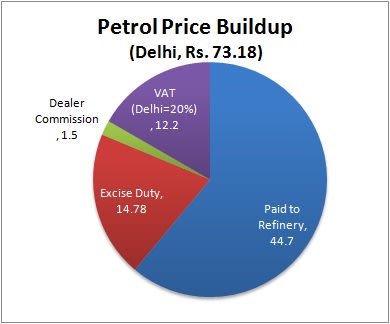
With a tax of Rs. 26 per litre, can they not reduce taxes? Goa, for instance, has cut state taxes to zero; this gives the Goan petrol pump the ability to sell petrol at Rs. 61, a good Rs. 12 less than the Delhi price of Rs. 73. How, though did the brand new Chief Minister, Mr. Manohar Parrikar do it?
He replaced the lost revenue on petrol by increasing taxes and fees everywhere else. After the monsoon session, you will have pay a toll tax just to enter Goa. Alcohol will be more expensive. A power of attorney that used to cost Rs. 25 will now cost Rs. 500. A 10% luxury tax now applies to beauty parlours. Cars get more expensive with entry taxes, VAT increases and higher road taxes.
So do you really want that, fellow Indians? That the government cuts taxes on petrol and diesel, and instead makes it more expensive for you to do anything else? Goa made the grade, and has not yet seen the impact — of lower consumption due to the higher taxes. Other states, which are more dependent on the fuel revenue than Goa, might not be able to comply. Regardless, it is highly unlikely that we'll stay wedded to a low petrol price if it means higher taxes and prices elsewhere.
State VAT is only one part of the tax problem — a larger chunk is the centre's "excise duty" which adds Rs. 14.78 to the petrol price, and which if brought down could make life a little easier for those of us that travel in petrol vehicles. So why can't the states and centre cut taxes together?
The central government isn't earning much more than it did, and if you take away some tax revenue, the gap between income and expenditure — a wide one already — will widen further.
The second argument then is: the government needs to spend less. That it does. It spends a lot of money just paying the oil companies for their taking losses on diesel and kerosene. In effect, a portion of what it collects as tax on that fuel goes back into paying for the losses incurred on these fuels. Yes, the government could cancel them out — reducing the subsidy while at the same time cutting taxes on diesel. But that won't touch the petrol price — which isn't subsidized, and the losses due to a cut in taxes won't be nullified in any other way.
Why can't the government cut taxes anyhow? Cutting government revenues is a problem of optics. Imagine being told that you must take a cut in salary, because the government just cut your income tax rate by 20% and inflation is only 10%. This is not acceptable to most people, although they might universally agree that a tax cut puts more in their pocket than earlier. A drop in revenue, for the government, is unthinkable, even if they did manage to cut expenses.
And there's the political problem of austerity. Spending lesser means cutting government employee salaries, cutting farmer subsidies like fertilizers, reducing the wages paid in the NREGA scheme or otherwise spending lesser on infrastructure. All these solutions have political problems, and the government will do all it can to prevent a backlash in these high-voter areas; petrol users are simply those that have enough money to avoid public transport, but not enough to buy a diesel guzzler, a population that is, by and large, not inclined to vote either. Most unrelated expense items have been cut already, even as the fiscal deficit — a measure of how much more the government needs to borrow to match expenses with revenues — ended up over 5% of GDP.
Prices also give a signal. If you raise prices, you lower demand. And undoubtedly, we need to reduce our reliance on petrol and diesel, which come from crude oil, our largest import. We import around $150 billion worth of crude oil every year, a figure that only increases as crude oil reaches new heights. This increases our trade deficit, and reduces the value of the rupee in dollar terms, which, in the end, makes our petrol more expensive in rupees. Our consumption hasn't slowed, mainly because we prefer, as a country, to not pass on market prices to our consumers. Effectively, without a price signal, consumption patterns don't change. Freeing prices may make them volatile, but we have lived with volatile necessities for years — no one, for instance, calls for potato prices to be regulated. Even the search for alternative fuels or the encouraging of cheaper ones like natural gas will not happen as long as prices for current fuels remain subsidized.
On that vein, diesel prices must be increased as well, and LPG. The oil companies lost nearly 140,000 crores (Rs. 1.4 trillion) in diesel, LPG and Kerosene last year, half of which the government must bear.
Petrol prices may come down anyhow. The calculations above reflect a crude price of $124 in April, which has since fallen to $105 recently, even as the rupee touches Rs. 56 versus Rs. 53 earlier. Net of the above, petrol prices can fall to nearly Rs. 64 per litre, without any changes in state or central taxes. But that shouldn't change the view that prices need to stay deregulated. After all, when international prices go down, we won't like the argument that they can't cut prices until they make up for past losses.

The Macro Trumps the Micro

You can't buy stocks on merit anymore. You can do the most beautiful analysis about a company that owns a toll bridge, and how many cars pass through it every day, and how they can increase the toll fees every year by 10%. And how there is this airport proposal which, when cleared, will dramatically increase toll fee collections. Finally that the contract with the government guarantees a 20% return on investment.
And all of this analysis tells you that the stock should be worth five times the current value in a few years. Yet, it all amounts to nothing when suddenly, the government decides not to allow any toll fee increases because of the bad political mileage they are getting for not keeping onion prices in check. And then the government runs out of money because of profligate spending on random other causes, and investment flows into the country stop because no one in power can take a decision anymore, and the powers decide to tax everyone they earlier hadn't taxed. To gather more money they introduce special taxes on toll collections that crimp margins further. Adding even more misery is that the rupee-dollar equation has changed by 30%, creating a huge gap in the repayment of loans borrowed in dollars. Something that happens in Spain causes a foreign company to go bust, which it turns out was a key shareholder in the stock — their liquidation floods the market with shares and in turn, destroys the stock price.
Spain, Government finances, rupee-dollar or political problems are not something you ever would factor into an analysis of a company whose only business was to let cars go over a bridge and collect toll. You've just been trumped by the macro.
The macro, in my mind, is the broad area that comprises macroeconomics, like the European debt crisis or the U.S. housing slump, which has an indirect but substantial impact on stocks that otherwise seem unlinked. The micro, on the other hand, is directly related to the company you want to buy — sales, profits, business prospect or market share. Investing through the micro has been a preferred path for many; for instance the rural story in India is about FMCG and motorbikes. But the macro now seems to have added itself as a parameter, almost like an uninvited guest, so now you have to think of FMCG, motorbikes and potential Greek default.
Crude oil prices used to change with supply or demand imbalances. It's no longer just about supply and demand; even large countries are buying crude as an investment, sometimes even hiring ships to store them in the open sea on anchor — when the time is ripe, they will sell, they think. Much of that is fuelled by cheap loans given to banks and financial institutions, in some kind of "quantitative easing" which to the banks sounds like, "heads I win, tails you lose". Another macro that trumps the micro.
The trouble in Europe is turning out to be so large that nearly every statement that involves looking forward into the markets ends with a disclaimer like "Will not apply if Europe'situation deteriorates". How Greece affects a company selling quilts in Andhra Pradesh isn't apparent now, but it will be in hindsight when the bad stuff does hit the fan, prompting you to wonder, "Now why didn't I anticipate that?" The answer is that you simply can't, just like you don't think of whether the metal wires holding up your elevator are strong enough to take you up.
And what's happening now is that the picture is all about posturing and anticipation rather than the fundamentals. Housing prices have fallen? Well, the market will now go up, because they believe that the authorities will introduce another round of "quantitative easing". The rupee fell some more? Oh, the RBI will protect it. The words that powerful people use in their carefully rehearsed statements tend to roil markets — so the powerful people try to use words to manipulate markets in the direction they want, rather than following those words up with action. It's a world with financial systems that are of such stupendous size that even a tiny problem with "confidence" can rattle entire countries. Case in point: Spain's bank deposits fell by 31.44 billion Euros in just April, on the fear that like Greece, there may be the need to invest away from the local economy.
You wouldn't be alone wondering if the macro impact remains an unfounded fear or is really a train wreck in slow motion. The sane reaction is to stay out of it until there is more clarity, which unfortunately exacerbates the crisis — to the extent that certain governments, including India's, believe that things would be perfectly fine if we simply didn't have access to bad news.
But news has a way of finding its way home, and there's no sense pretending that we are unaffected or, in investment parlance, "uncorrelated". The reasons to buy companies or sell them must include a check on the "macro". The rupee creates a problem for everyone if it slides so much (more than 20% in a year). The government's lack of tax collections and affinity for overspending will result in their taking on even more debt from the market; thus impacting the borrowing costs of your company. The European equation is an unknown-unknown — we don't even know how much a "contagion" will spread, should the bad stuff hit the fan.
It's no longer about companies or places or people anymore. The macro is today a much bigger factor. And that is indeed sad.

Diversification: The Pluses and Minuses

A lot has been said about diversification, where you spread your investments across various avenues. The plus point is that you don't have all your eggs in one basket, and that if one of your investments falters, another will balance it out.
Diversification in stocks means you buy many stocks, in many sectors. While that exposes you to a stock market crash, a fall in one sector doesn't usually hurt another. However you must be careful that these sectors don't impact each other; for instance, buying a steel maker and then a car manufacturer is not really diversification — a fall in car demand will hurt both sectors. Diversification is also employed by those that either have no time or skill to handle investing decisions themselves; often, it's known as a tool for the ignorant.
You could buy multiple asset-classes. Like Gold, real —estate, stocks, bonds, commodities and rare stamps. These asset classes, while providing a layer of diversification, often have varying liquidity problems. You can't sell a real estate investment in a hurry; and when stocks and bonds are down, you may find no takers for your gold either.
A mutual fund is, by definition, diversified. Each mutual fund invests in a bunch of stocks that their fund manager likes. Yet, people buy multiple mutual funds from different fund-houses, assuming that they shouldn't concentrate their bets on one fund. While having two funds might make sense for this purpose, it serves no useful purpose to have ten different equity mutual funds in your portfolio. If you were to do the (tedious) exercise of getting each fund's investments, revealed on their web sites every six months, you might find that the ten funds eventually have a significant overlap in what they own. Buying 10 funds, each of which has a strong weight to Infosys in its portfolio is not diversification.
To not diversify is also beneficial. Companies prefer to take loans from banks directly, instead of issuing bonds even if bonds would result in a far lower interest rate. Why? It's not just because we don't have a flourishing bond market — a bond market, though, can only flourish if enough companies issue tradeable bonds, which is a chicken-and-egg situation. Borrowing from a bank, even at a higher interest rate, has an advantage: If things go sour, you can always approach a bank to "restructure" the loan, increase the payment tenure, change the loan parameters or such.
What do you do if you issue bonds that are held by hundreds of faceless entities who change every day?
If you don't pay, you default. A default is a bad thing; it causes the bondholders to go to court, requiring you to sell whatever assets you have to make good on the loan. This action then forces other lenders, even banks, to have to demand their share. Most companies don't have enough cash to pay for whatever they have borrowed, and if they have sell whatever assets they own, the company then doesn't even have the resources to earn the money to pay.
But then, keeping your loans with the banks makes them arm-twist you, demand seats on the board, charge high random fees and in general reduce your ability to find a cheaper loan at another place. The risks of concentration are in the power that is held by a few. Recently, the Life Insurance Corporation of India (LIC) invested a large amount in a follow-on public offer of ONGC shares; it turned out that they were eventually the buyers of over 85% of all that was on offer, paying Rs. 10,000 crores (Rs. 100 billion).
Why were we outraged? Because the money is really the investment portfolio of many insurance holders, whose money is managed by LIC. Since we allow LIC to manage our money — through pension plans or life-insurance-plus-investment products - we face the risk that the capital can be misused or forcibly invested in avenues that don't deserve it. The problem is that we concentrated our bets in an insurance company, but we don't have the ability to withdraw (most insurance products penalize you heavily for early redemption).
You needn't diversify when you have the ability to influence returns. If you own a company, you probably have all your wealth concentrated in it, but that is not bad. You might have a good thing going, or massive growth on the way, and you know you can change track when things go wrong. A passive investment in Company X gives you limited visibility and flexibility; it is indeed better to put money where you know more and can react better. It is for this reason that a fund manager is expected to keep his wealth in the fund he manages.
An attempt to diversify can sometimes go horribly wrong. In the US, large banks bet on the housing market thinking that a fall in a house price in one area won't affect another. That bet turned sour as the market saw a large fall across-the-board. Certain banks converted loans to securities and then, split those securities into "tranches", which were then packaged into other pools of loans. You could then buy a piece of a pool of just the riskiest tranches which paid a high rate of interest but were given a "AAA rating". Because rating agencies believed diversification to be a magic wand that makes your risk disappear. It's only making the rating agencies disappear.
Finally, to borrow from Peter Lynch, you can diworsify. To buy into too many things means you need the effort to manage and track each of them, and the effort required can take away from your primary job. Or your investments can themselves diversify and muddle your portfolio. Venture funds in India made high profile investments in e-commerce firms, all of whom were doing different things ("deals", "books" , "fashion") and now each of them sells everything from bestsellers to toothbrushes. What started as a diversified investment is now a set of companies that cannibalize each other — to the extent that some are buying other companies just to shut them down.
A large healthcare company has big investments in a mobile phone company. A shoe manufacturer owns swathes of land it will convert into a commercial and residential real-estate business. An oil company owns retail stores that sell vegetables, a cigarette manufacturer owns hotels. Some of these will work, some won't — but it just makes it harder for you to really diversify.

India’s Broken Interest Rate Transmission

Growth is slowing. At the 5.3% official growth rate, India has grown the slowest in the March quarter in 8 years. Even that is considered suspiciously high, since we are shown a massive growth in exports and subdued imports that no other data point seems to corroborate. The Reserve Bank of India needs to cut rates, say many observers, while fighting for an armchair with yours truly.
RBI controls the rate at which banks can borrow from it, overnight, called the "repo" rate. If they do cut interest rates, how does it impact growth? The traditional answer — when banks can borrow at lower rates from the RBI, they will cut rates for industry and consumers, who will find their loans cheaper and thus make more profits, which will fuel investment and consumption and overall, more growth.
Let us pause for the realists to stop laughing.
In India, this "transmission" of interest rates is broken when rates go down. Bank loans can be at fixed or floating rates — for a fixed rate borrower (such as a car loan) there is no impact of an RBI rate change. For floating rate loans, banks are quick to raise customer interest rates when RBI raises the repo rate. But when RBI cuts rates, banks don't cut customer rates easily; stating that their cost comes largely from fixed deposits, where they can't change the interest they pay.
This would be true if their real source of funding was fixed deposits — increasingly, banks fund their costs from low-cost "current account/savings account" deposits, where they pay between zero and four per cent per year today. Secondly, high cost fixed deposits can be converted into floating rate loans through an interest rate swap.
But what if other banks provide cheaper loan rates? Won't the competition force banks to cut rates? This would be true if customers could easily shift loans to other banks. They can't, partly due to high prepayment penalties on loans. Typical loans come with a 2% to 4% early payment penalty.
Recently, RBI banned all prepayment penalties for floating rate home loans by banks. But when the National Housing Bank, the regulator for Non Banking Finance Companies like HDFC and LIC Housing Finance had banned such prepayment penalties, they later issued an ominous clarification. Most housing companies had offered loans that were fixed for a few years and then converted to floating rate — the NHB then clarified that such a ban on prepayment penalty would not apply to such "hybrid" loans since the loan was fixed at the time of entry. And then, to be able to levy a penalty, certain financiers introduced a loan that was fixed-rate for 3 months and then reset to a high floating rate. (Ref: Harsh Roongta)
While the ban on penalty would have helped transmit the interest rates down to borrowers, such a ban only applies to a small variety of loans (pure floating rate housing loans). Personal loans, corporate advances and other such loans can have a penalty that restricts borrowers from getting the best interest rate available.
You might say that if loans are floating rate, then they will have to come down anyhow, since loans are now linked to a single "base" rate. Sadly, that is also not true — even "floating rate" loans are connected to the base rate by a spread, of say 2%. Banks tend to retain the same base rate, while attracting new customers with a smaller spread of, say, 1.5%. That means banks will continue to milk existing customers at higher rates while exciting newer customers with a lower one; and existing customers can't even move because of a penalty.
The other argument is that if banks won't lend at lower rates, corporates (who have 50% of all bank loans) will go to the bond market instead. This would be true, if India's bond market wasn't ridiculously underdeveloped. One reason is that companies that issue bonds in the market need to take care of a much more diverse set of investors, and if they are in trouble, they won't get much leeway from them. Banks on the other hand are only too keen to restructure loans at the first sight of something going wrong, because that way they don't have to classify them as a default. Unscrupulous promoters that siphon money out of companies might use this route to have banks fund their lifestyles. While banks need to provision (set aside capital) for a part of restructured assets, RBI even forgives certain instances (like Air India recently), if only to protect the existing set of banks.
How, then, can RBI and the government create a better policy for transmission?
First, create competition. RBI must acknowledge that we have too few banks, and we need a lot more banks. Not 10 more, like they promise and forever leave in abeyance. But 20, 50 or 100. Let's not restrict the number of banks, just set the criteria for them to exist.
Second, penalize bank loan restructuring. The transmission policy is weaker if banks are the only source of funding. We need to encourage banks to find other sources of funding and to keep their options open.
Third, encourage the bond and currency markets. The current set of regulations restricts banks from being large players in the exchange traded currency markets. Who can play these markets are further restricted. Foreign investors are discouraged. These things need to change.
Fourth, cut prepayment penalties on small loans. Given the level of derivatives in the market, banks can convert their fixed rate exposure to floating rate to a large extent. It would be better, for transmission, if the RBI restricted all prepayment penalties for all types of loans below Rs. 1 cr. to, say, 0.5%. This is not new; IRDA has disallowed surrender charges on unit-linked insurance products to a maximum of Rs. 6,000.
Lastly, the government must allow companies (and individuals) to declare bankruptcy. In a crisis, too many entities stay in limbo with no capacity to repay. They have to be given protection to let them pick up again, from scratch if necessary. The closure it will provide to banks will also ensure they can finally declare their losses and move on (and if necessary, go bust themselves). The process of creative destruction is well known to us — there is even a Hindu God for it — but we don't seem to want to let it happen.
We'll soon move to a regime where RBI will start to drop rates to encourage growth. But it won't work if their cutting rates will not help the eventual borrowers. And that won't help growth, the lack of which drives rates cuts in the first place.

Making Sense of Dividend Announcements

"1860% dividend announced", goes the headline. You're excited. But the question isn't, "Where do I sign?", but "1860% is great, but a percentage of what?"
The number is a percentage of "face value" which is as relevant today as a rotary-dial telephone. When a company is created, the founders distribute the initial capital into shares. A company started with Rs. 100,000 could be split into 10,000 shares of Rs. 10 each (the "face value" per share).
This company can, over time, earn enormous profits without any further capital requirements. Or, it might borrow money from a bank to fuel expansion and as it profits from growth. The capital could remain unchanged, with the original shares changing hands in a stock market. If the company grows to earn, say, Rs. 10 crore (Rs. 100 million) in profits, and decides to distribute half of it as profit, what happens?
You have a distribution of Rs. 5 crore (50 million) divided over 10,000 shares, or a dividend of Rs. 5,000 per share. The "face value" is still Rs. 10. So this is, effectively, a 50,000% dividend.
But the face value is irrelevant if you bought a share at Rs. 100,000 per share; for you, it's a 5% dividend! The "50,000%" number has no significance.
Most companies insist — and some say there is a rule for it — on providing dividends as a percentage of face value. Mutual funds are mandated to provide both the value of dividend they offer (rupees per unit) and the percentage of face value which is usually Rs. 10.
For listed companies, a better way to represent dividend is the "yield" — or the percentage of the stock price). But there is a practical problem: the dividend is proposed (and announced) as a number per share, by the board, and approved at a general shareholder meeting a couple months later. And then, it takes another few weeks to actually pay out the money. In this time, the share price could have moved substantially away from the time when it was first announced. A Rs. 10 dividend on a stock priced at Rs. 500 is a 2% yield, but if the price moves down to Rs. 200 due to a global crisis before the dividend is paid, the yield is actually 10%.
The other problem is that face values are different. Some companies have a face value of Rs. 100, others "split" their face value down to Rs. 2 or Rs. 1. You have no idea what a "170%" dividend will mean if you don't know what the face value is.
Some companies issue bonus shares, a process of converting retained earnings into share capital. So a 1:1 bonus will effectively double the number of shares in existence (each shareholder gets to double his holding). But since it's the same company whose profit is now being distributed over a larger number of shares, the market price per share will go to half. If the company paid "100% of face value" as dividend earlier, it might only pay "50% of face value" today — yet, a shareholder will get the same amount!
The simplest way to represent a dividend is to state what percentage of profit is being paid out. A company making Rs. 10 per share as a profit could pay out Rs. 2 as dividend — the dividend distribution percentage is thus 20%. Even this has a disadvantage; since a company can pay dividend from both current and past profits, it might just turn out that some companies pay out 170% of their annual profits, which might confuse investors. (How do you pay out more than you earn?) But it is substantially better than the current "of-face-value" method.
Face value has lost relevance as companies in India have grown without the need to add more capital, and retained most of their earnings for future expansion. Paying out dividends means an extra dividend distribution tax, so companies will retain more profit back. Most times you won't even know what the face value of a stock is — for instance, Infosys, which trades at a price of Rs. 2,500, has a face value of Rs. 5, while Reliance Industries (which trades at Rs. 735) has a face value of Rs. 10.
If you'd still like to chase a high number, Hero MotoCorp has just proposed a dividend of 2,250%. What that means: It's a Rs. 45 dividend on a share that's priced at Rs. 2,000+. You just can't take dividend announcements at face value.

The Internet of Finance

20 years ago, you had very limited choices when it came to knowing, analyzing or buying financial products. You went to a bank for a fixed deposit and nothing else. A stock broker would sell you stocks. To get information about companies, you would either buy a (hopefully unbiased) magazine, or go through the cumbersome process of requesting physical annual reports for analysis. You wouldn't know about competitive products or better rates unless you were willing to toil and wait forever.
Everything has changed today. Fixed income no longer means just a fixed deposit; it could mean a fixed income mutual fund, a bond traded on a stock exchange, a government security bought at an auction. Banks and stock brokers and nearly every financial advisor will sell you all these products, mostly at the same time. Stock exchanges and the regulator (SEBI) have tightened disclosure requirements, making it mandatory for listed companies to provide information to everyone on a regular basis. We have gone from too little information to too much.
The internet has helped substantially helped investing and finance in general.
Discovery has become easier. How do you know where to invest? For stock market investments, exchanges provide a wealth of information, including stock prices, historical charts, and financial results. Mutual funds provide a daily unit price, information about products and even portfolio details regularly. Bond markets help corporate investors by providing details of every single trade.
Transactions are now less expensive and more spread. If you had to find a "Bombay Broker" earlier, today you can execute a stock market trade through a terminal located in the remotest corner of India. Or on the internet, or on your mobile phone. Trading costs have come down from the average 1% per trade we were used to earlier, to less than 0.20% today. Technology has rapidly scaled risk management, where brokers will square off your trade automatically if you lose more than your "margin", instead of the earlier method of hoping you will somehow find the money to cover your losses.
Management and Tracking is better — as prices change every day, what you own changes in value; many online web sites now allow you to track your portfolio.
Disclosure and regulation have improved. You can take your contract note and verify it against the stock exchange — earlier, there was no way you could verify your trades happened at the price your broker said it did. Regulators now specify that any shares bought or sold by an "insider" or even a "substantial acquisition" must be revealed to investors — this is revealed on exchange web sites.
But still things need to change.
Abuse has increased. With electronic transactions, unscrupulous agents have been able to route investor money into their own accounts and rapidly trade it, creating losses. With way too many products, financial intermediaries have been able to confuse investors and prod them into products that provide higher commissions, to the investor's disadvantage. Technology helps in obfuscation, because if you get a complicated page consisting of numbers that end up with your owning Rs. 1 crore in 30 years, you're likely to rejoice instead of doing the actual calculation that the return is approximately 4% a year, less than you can get in your bank today. And then, the dark side of the internet consists of people who manipulate stocks by posting biased comments on stocks they own, promising dream returns while selling their inventory.
You still can't easily buy financial products online. Onerous requirements of KYC (Know Your Customer) make it difficult for any new user to buy products, but the bar isn't high enough to weed out the dirty people the KYC system was created for. A fixed deposit still needs physical signatures. To create a brokerage account or to buy a mutual fund, the regulators need further proof that you really exist, in the form of an 'in-person verification'.
There is hardly any investment in investor education. People get carried away with the fast pace of trading shown on TV channels and lose money — regulators, instead of creating more awareness, have decided that people with less money shouldn't even be allowed to trade products like derivatives, with the crude barrier of providing an "income proof". Too many products and too little education mean people will get suckered every single time.
Regulations are inadequate. Companies aren't required to provide balance sheet and cash flow statements every quarter, though they must provide profit statements; this isn't enough for investors to really gauge a business. Real estate investments have very little regulation or protection for investors. Traders create complicated methods of stock manipulation through robot-controlled trading, and regulatory fraud detection technology has lagged behind.
But there's no rolling back the use of technology in the field of money. It's enormously powerful in its simplicity — I can learn, I can buy, I can manage and I can sell with nothing but a connection to the web. But with great freedom, comes great responsibility — to attract the next round of investors, our systems need to address abuse, education and regulation.

Is the Indian Consumption Boom Over?

Things are changing, ever so slightly. The story of the last 10 years has been that of an incredibly shining India and much of that shine has had to do with factors that aren't Indian. But the result has been a rapid increase in consumption that has made for very profitable consumer facing industries like motorbikes, cars, FMCG, retail, mobile phones, pressure cookers and so on.
But is this growth stalling? There is both evidence and reasons to suspect that we might be headed in the other direction.
Much of the rapid boom in consumption over the last 10 years has been on the back of low interest rates (relative to inflation). Credit growth has been as high as 30% year on year, and people have borrowed to pay for consumer durables - from fridges to TVs to mobiles to what not. Manufacturers have been happy to provide interest rate subventions if people would actually buy - you might remember the days of "zero interest EMI" payments to buy TVs, and I've personally benefited from them.
But low interest rates, relative to inflation, have a cost, in the form of higher eventual inflation. To curb this inflation, the RBI will raise rates - as it has, to about 8% today. This has not dented inflation in any reasonable way, and it's quite likely that interest rates will remain high. High interest rates make money expensive and slowly but steadily we've seen the zero-interest offers go away or reduce in tenure. In 2003, I bought a TV at a zero-interest EMI offer for 30 months. Today the best I can get is a 3 month deal on certain credit cards.
Another reason why credit growth slows is that banks are getting very jittery about NPAs. With large company defaults hurting their capital, banks loathe to lend where risk is higher, as it always is in a TV loan (the collateral is useless for the most part).
Inflation has another problem - when the "necessary" goods gets expensive, people cut back on the "nice-to-haves". When petrol and food get lower discretionary spending means lesser money spent at restaurants or on cars or on luxury travel.
Look also at the macro reason why India got so rich so fast. The west was printing too much. To save the US economy from the crises of 2000 and 2001, Greenspan kept interest rates too low for too long. Much of that money got into India as well, like an overflowing drum will spill in every direction. Now the quantitative easing is finally over, it seems.
And this will impact how much money comes into India. Again, to keep the dollar-rupee equation stable, the RBI has, in the last decade, bought the incoming dollars and printed rupees, an exercise with increased supply of rupees dramatically. Just since 2002, the total amount of rupees in circulation - "broad" money supply if you will - has grown from 14 lakh crores (1 lakh crore = 1 trillion rupees) to 76 lakh crore, a near 15% increase year on year. Much of that money supply increase comes from buying dollars, remember - and in the last one year, we have only seen an outflow of dollars. Money supply growth rates have fallen, to as low as 13% recently.
How does this impact consumption? If there's more money to go around, more money will be spent. When money becomes scare and expensive, and inflation remains high, then people spend more on necessities and less on other things.
We have a deficient monsoon. Much of our farming still depends on the water provided by the south west monsoon rains, and till July 17, we lagged 22% behind "normal", and over 60% of the Indian area received less than normal rainfall. India considers it a drought when the full season rainfall is less than 10% of normal, and covers more than 20% of the area. A drought needn't always be a problem; indeed, 2009 saw a deficit of 22% in rainfall, and it was a great year for the economy (visible in 2010). And much of the full season still remains; we'll have to take a real call in September. The monsoon impacts rural consumption to a great extent.
Most FMCG stocks haven't yet shown an impact but we have data that demonstrates a consumption slowdown. Car sales in July showed the biggest drop in 3 years. Real estate sales have flattened (though prices aren't down yet). Air travel in January to July grew a mere 3.7% from a year earlier, and nearly all operators are bleeding. Mobile operator revenues and profits are at a plateau. Slowly, we hear about continued operating losses at e-commerce firms. There are whispers that many investments made on the basis of the great consumption story might have been too optimistic.
The turn of a consumption boom isn't necessarily bad, of course. You might get some bargain deals when someone goes bust. Other firms get acquired by competitors who can now take advantage of a larger network. At the same time, that salary hike may not break into double digits. It also means lower income at the "poor" end of the economic chain, where the impact is felt the most. And finally it means lower stock prices. There are many ways to change the situation, and the government portion largely consists of the phrase: "Do not be paralyzed".
But before we get to solutions, it's important to acknowledge that we have a problem in the first place. It would be a shame if it took the President of another nation to tell us.

A Blunt Regulatory Knife

Imagine criminals that have sophisticated guns, satellite radios, bombs, strong armour, GPS trackers and fancy cars. And imagine someone has been given the task of "policing" them from a bullock cart, with only bows, arrows, and a sign that says "Stop, or I'll say stop again".
In the civilized world, it would be entirely unnecessary to kill the regulator. As long as you have the technology, you just have to get away in your car when a bullock cart chases you, and let your armour take the brunt of any bow or arrow that's fired.
This is how our regulatory system is.
Bernie Madoff was "discovered" at about the same time that Satyam founder Ramalinga Raju admitted he fudged accounted. Mr. Madoff is now cooling his heels in jail, where he will be for the rest of his life. Ramalinga Raju's only relation with heels is that he's probably getting a pedicure - he is out on bail and the cops haven't even been able to cobble together a case.
That story isn't the only one. The 2G scandal involving A. Raja hasn't seen a conviction. The Adarsh housing scam is still "under investigation". The Commonwealth Games scam, the Tatra scam, and even the Fodder scam of 1996 (which has only recently seen charges framed!)
It is no wonder that fraudsters operate with impunity. We just do not convict white collar criminals in India.
It's not just plain outrage. In many cases the penalty does not even meet the scale of the crime.
Recently, the Insurance Regulator, IRDA, passed an order against HDFC Life Insurance, asking it to pay a fine of Rs. 35 lakh. The crime? That it paid certain linked corporate agents, like HDFC Bank and HDFC Securities, excess money in the name of "marketing expenses". They were paid Rs. 428 cr. and 133 cr. respectively, which was more than 2.5 times the money actually spent.
Think about it. You spend Rs. 200 cr. You get reimbursed with Rs. 428 cr. And you pay a Rs. 0.35 cr. fine. You'll take that deal every day of the week. And it's not IRDA's fault — it seems they can't fine more than Rs. 5 lakh per "instance", and there were just seven instances.
SEBI, the securities regulator, had provided a "consent order" against Anil Ambani and his aides in 2011, allowing them to pay Rs. 50 crore and banning them from the securities market for about a year. It has turned out that in an enquiry, a UK Tribunal found that a certain Sachin Karpe had created a front for Ambani's RCOM, using a Swiss bank account and a Mauritius entity to trade RCOM shares. The profit? Potentially, Rs. 600 cr. A fine of Rs. 50 cr. with a meaningless ban, to earn (and keep) a profit of Rs. 600 cr? That is one sweet deal (and SEBI doesn't even have the limits that IRDA does)
But it's not always the regulator's weakness. A regulatory order can be appealed at multiple levels, which in India just means a very long delay. Case in point: a brilliant order by SEBI against the Sahara group essentially cancelling a debt offering of over 20,000 cr. has been upheld by SAT and then has been stayed by the Supreme Court, and could take a long time to run through. While the appeal process is a principle of justice, it would indeed be a shame if the system is being subverted only to buy time.
Recently the Competition Commission of India fined certain cement companies over 6,000 cr. — about half their profits of the last two years — for forming a cartel and hiking up prices artificially. It had earlier fined DLF over 600 cr. for abusing its market dominance in Gurgaon. Both these awards have gone on appeal, with a tribunal asking CCI to justify the fine amount in the DLF case. A proper method to calculate fines, with an additional amount for punitive damages to discourage other wrongdoers in the future will solidify the case for CCI.
When regulators overreach, there may be further trouble and a need to counterbalance them. And it causes damage when a regulator is a participant as well. The Reserve Bank of India is a bank regulator — it is the lender of last resort and the authority all banks must report to. Yet, it is also a player in the foreign exchange market. It is also the merchant banker to the government for selling GOI bonds. These introduce unnecessary complications; these functions should be moved out into independently managed institutions, even if the initial manpower comes from the RBI.
Regulators need to be able to disgorge all profits and then charge further fines. If a bank missold a policy to you, the bank should not only reimburse the policy amount, but also pay a fine, part of which goes to you. If a promoter earns illegal profits through insider trading, the full profit should be paid as a penalty with a further fine, including 18% interest for the time they enjoyed the money. Appeals should be dealt with swiftly, in all channels including the Supreme Court. Regulators needs strength and teeth. If we are outraged that doctors can get away with murder or that the ICAI has not still taken action against the Chartered Accountants at Satyam, we need to force our government to give the regulators more power, and provide the public accountability through mandatory reporting and RTI based disclosures.
After all, you can't take a knife to a gunfight.

The Kiss of Simplicity

Imagine a world in which you had very easy-to-understand financial products. I'll detail a few below.
Simple Life Insurance: You pay us non-refundable premium every year. If you die we pay your family money. This much money. If you live, your family is happier. Over and out.
Simple Mutual Funds: They come in three varieties:
a) Simple Equity Funds: We invest in the stock market. Forget Large cap or mid cap, forget this sector or that. We know what to buy, and we'll give you the fund manager's resume and past performance. We benchmark to the NSE Nifty. We don't pay dividends. We don't give bonuses. If you want to sell, you sell.
b) Simple Debt Funds: We buy debt. We know we can buy short term, long term, gilt, corporate, CDs, CPs and all that. But we decide what to buy. You just park your money with us. We are risky.
c) Simple liquid funds: We're better than fixed deposits for tax treatment. We only invest in bank CDs which are like fixed deposits except they pay us more than they'll pay you. We don't tell you how much interest you will get, because we don't know.
Simple Fixed Deposits: You pay us today. We pay you back tomorrow with interest. If you withdraw early, we charge you a penalty that's written right here based on when you exit. Your interest is taxable.
Simple Stock Markets: This product should not be allowed to exist. There is no such thing as a simple stock market. The market is complicated. People who made money without knowing anything are just lucky. It's full of information assymetry, unfair advantages, money power and other difficult concepts that are in no way simple.
Every Mutual Fund house or insurance company should have only one product in each of the above called "Simple". The costs should be regulated. There should be no entry load or exit load of any sort. Annual Management fees should be a max per product type and no other fees should be leviable.
Everything else is complex, so they are labelled "Complicated and Risky". So you have a sectoral fund? It's Complicated and Risky Technology Sector Fund. You want a Gilt fund? It's a Complicated and Risky Government Securities Fund. Similarly, a Complicated and Risky Balanced Fund. Even if you have an "ultra short term" fund to do some tax arbitrage, you should have to name it Complicated and Risky, because anyone in this industry knows that this stuff *is* risky and complicated.
Some will complain that this is needless regulation. I think this is worth thinking about. The problem in financial products is misinformation, misselling and complexity. When you label something as "Complicated and Risky" it will be much easier to say no, and to go for the "Simple" products. The Simple products could of course be missold but it's tough to missell a plain vanilla product that offers next to no commissions. Sure, the Complicated and Risky products could be missold but at one level there is a warning right out there in the name! And the misselling isn't any worse than is happening today.
Others will say we should do more: make people go through a test to prove financial intelligence before they buy a "Complicated and Risky" product. I think that's overreaching and unnecessary; it only ensures another layer of corruption in this "proving financial intelligence" procedure. (If it's a test, your agent will do the test for you, as an example of corruption)
How then do distributors get paid? They charge the end users, or get paid trail fees. With simple products there are no loads so they have to wait a year to make money. With complex products they can earn more, and it's their job to placate investors scared of "complicated and risky" - here, people will realize that complicated products aren't for the faint hearted.
But there's always the problem that some people want to portray that they know way more than they really do. So you don't buy a "simple" product because you want to show off that you know your stuff and therefore need to have a "Complicated and Risky" item in your portfolio. This is classic sucker material and such a person and his money should soon part, so let us not disturb evolution from taking its course.
Simplicity also means less legalese. An application form should ask just for a single Know-Your-Customer (which every investor should have in a common format) and provide strong but consise details; for example a "simple" mutual fund should only show the photo of the fund manager, his resume and a comparison with the benchmark and other "simple" mutual funds.
All requests for complexity must be thrown out. No dividends in simple mutual funds. If you want dividends, buy a complex fund. No Simple Endowment Policies. No Simple Index Funds. No "options" to check in a simple product. Simplicity is the absolute base; everything else is a separate complex product.
When regulators blame a lack of investor education for the rampant misselling in vogue, they must realize that a big reason investors buy into complexity is that there is no clearly earmarked simple option. You find complex fixed deposits, like those from which you can partially withdraw, like those that are linked to loans and so on. But still, the plain vanilla fixed deposit sells, because it is plain and vanilla and everyone knows it exists.
The KISS Principle that applies well here. Keep It Simple and Straightforward.

Maid Economics

The luck of the draw has allowed me to live in various cities — most recently, Gurgaon and Bangalore. In every single instance, residents of the apartment associations have complained of how maids or drivers or household help in general have raised their prices.
Or that they leave to take up another job for a marginally higher pay. Or that they become "arrogant", demand advances and bonuses. The response of the employers is to attempt to create rules for the "society" such as:
a) Provide a chart of pay for activity and tell every household to pay only that much.
b) Ask for "no-objection certificates" from past employers if any household help attempts to move elsewhere.
In my opinion, this is the possibly worst response to rising wages. Let me replace the word "maid" by "software engineer". Would we be happy if companies got together and said we'll only pay this much for this job — and no other employer can offer you more? If this actually happens, it could be construed as an attempt to cartelize and force artificial pricing in a free market — the market of jobs.
Our household help is no different. Considering that salaries in general have gone up, and that more and more people require regular household help, it is only likely that the prices of pieces of work will go up. Supply of such people isn't increasing dramatically — especially in cities like Bangalore or Delhi — and demand is rising exponentially. Wages must go up, and it would be silly of us to try to prevent that.
Secondly, any attempt to fix prices will be met with resistance, from homeowners themselves. If one person can afford to pay Rs. 10,000 per month and needs the help desperately, she will pay. It doesn't matter that everyone around her are only paying Rs. 6,000 per month for the same job. You might think that this is a disservice to society, but the hurt you cause a neighbour will be negated by the joy you give a maid with the higher pay. And in the end, it is pure economics — I can afford it, so I will pay higher.
Also consider that people who work full-time or part-time in a household have a very tough job with skewed economics. A full time live-in household helper will usually be working from 6 in the morning to about 8 pm at night, with very few breaks, controlled food intake and probably an hour to herself during the day. No holidays. Even for those that work part time in each house — someone who sweeps and does dishes — will probably do 10 houses doing hard physical labour. This kind of work has a limited horizon — at the age of 40, they will probably have to retire and live off their children, as their competition (younger people) will have more energy.
With such a profile, they get no pensions, no retirement income (like gratuity or provident fund) and no insurance, health or otherwise, paid by their employers. They are also fired without severance, and sometimes can't even collect arrears. They are accused of theft if anything in the house is missing, even if it was thrown out by accident by the employers themselves. They don't get to unionize, or demand better working hours or conditions. They live a tough life and most live their lives with more smiles than I would if I was in their position.
Given all of this, it is very surprising that many of us think that when we give them a few clothes, or pay for their kids' education, it is charity. It is not. It is our job as an employer who won't give them any perks. And we still aren't doing enough; we need to be helping them save for the inevitably-early retirement.
One repartee is that maids and drivers themselves form a cartel. That they raise prices by discussing wages with each other and don't let anyone charge lesser. This is not just true of maids and drivers. It is true of software engineers, factory workers and even managers. Prices go up to the level that can be afforded. The correct thing to do is to ensure that no one tries to use force to stop anyone from offering their help, but beyond that, it's just market economics.
What we should aspire for is an India in which the cost of household help is so high that only the super rich can afford it. Not through artificial restrictions like a minimum wage or "licensing" or through hair brained NREGA schemes, but by free market measures. Because it means that those desperate for work (who currently offer services as maids and drivers) have found better paying (or more meaningful) work elsewhere, and that means they are no longer desperate. You might say this should include other professions like garbage collectors, security guards and so on — to which I agree, but economics states that if the pay difference is too high, they can always take jobs as household help. This means that if the wages of household help is out of reach of the "middle class", then every such profession gets high wages. And voila, being household help will become a middle class profession.
For that, we'll have to ensure that radical elements don't try to "throw out" people from other parts of the country (and if I must say it, other countries) to protect their own. We'll have to enforce the current rules such as no children below 14 working, and to throw any employers that have used physical force on their maids in prison. We'll have to find a way to provide health insurance to this unorganized group, and retirement benefits. And the "we" is everyone that is reading this article

Bharti Airtel says India CEO Sanjay Kapoor to quit

  Bharti Airtel(NSI:BHARTIARTL), India's top mobile phone carrier, said on Tuesday Sanjay Kapoor, its chief executive for India and South Asia, will leave the company on Feb 28.
Gopal Vittal, currently group director of special projects will take over as the company's India CEO, effective March 1, it said in a statement.
India is the biggest market for Bharti, which operates in Sri Lanka, Bangladesh and 17 African countries

AT&T Sold 10M+ Smartphones In Q4, Vs. 9.4M Yr Ago

AT&T this morning said it sold over 10 million smartphones in the fourth quarter, beating its previous record quarter of 9.4 million in the comparable year ago quarter.
“We had another incredible quarter of smartphone sales as the mobile Internet continues to drive strong growth in wireless,” AT&T Mobility CEO Ralph de la Vega said in a statement. “These are the industry’s most valuable postpaid subscribers with average revenues twice that of non-smartphone subscribers. During the quarter, we averaged more than 110,000 smartphone sales a day as customers flocked to our leading portfolio of the latest Android, Apple and Windows devices. Combine that with the nation’s largest 4G network and lightning-fast LTE network that now reaches more than 170 million people and you’ll understand why customers continue to choose AT&T in record numbers.”
AT&T will report Q4 results on January 24.
It isn't immediately clear how the 10 million figure compared with Street estimates, but in any case the Street reaction so far is muted: AT&T in early trading is up 5 cents to $34.99.

Bharti Airtel, Idea shares surge on call tariff hike hopes

- Shares in Indian mobile phone network operators Bharti Airtel Ltd and Idea Cellular Ltd surged on Tuesday on speculation that they may soon raise their prices for voice calls, several traders said.
Both companies declined to comment on the market rumours.
India's mobile phone market, the world's second-biggest by customers behind China, has not seen any real increase in call prices in the last three years after a vicious price war sent call prices tumbling in late 2009. Voice calls account for about 85 percent of revenues.
Companies including Bharti and Idea raised voice call prices in the middle of 2011 but then had to pare them back after losing market share to competitors.
But since then several smaller operators have either folded or cut back operations after a Supreme Court order to revoke licences gained in a disputed auction and market leaders such as Bharti, Vodafone Group Plc's local unit and Idea Cellular have long since been expected to increase call prices.
Bharti shares ended up 5 percent, their highest level since March 5, 2012. Idea shares rose 8.4 percent to their highest level since February 4, 2008.
Shares in Reliance Communications, India's third-biggest carrier by customers, closed 2.7 percent higher. The company, which was the most aggressive in cutting rates during the price war, raised call prices in some zones last September.